








Meta’s Muse agent fills most of its shopping shortlist from websites it opens in a browser, not from the Meta product catalog that hands it far more candidates, according to a test by AI visibility firm Profound.
Profound ran 50 prompts from a single consumer retail category through one Muse instance and set out the results in a research post on personal agents. On median figures per prompt, Meta’s product catalog returned roughly 60 products from 30 merchant sites. The browser visited three domains and returned four products from two merchant sites.
Muse’s final recommendations typically held six product cards, two from the catalog and four from the browser. On those medians, the catalog supplied about 94% of the candidates but only a third of the products a shopper was shown.
Profound describes the test as a small, exploratory sample whose patterns are illustrative rather than definitive. The firm, which The Keyword covered in June 2025, sells software that tracks AI agents reading websites.
How Muse Builds a Shortlist
Muse is the personal agent Meta launched on 8 September, and on 21 September Shopify said it would let Muse buy from stores on its platform. Profound sets out a shopping request in three stages.
Muse first checks the shopper’s profile, which records tastes by product category, and may ask follow-up questions. It then runs two searches at once. One is a browser session across merchant sites. The other is a query to a Meta product catalog, the same one that powers shopping on Instagram and Facebook. Candidates from both are filtered and ranked into the final set.
Profound says Muse can also draw on Facebook Marketplace. Instinct, a rival agent that works inside text messages, searches Shopify’s catalog instead.
What Profound Tells Merchants to Fix
Profound’s advice has two parts. Products should sit in the feeds agents draw on, such as Meta’s product catalog and Shopify’s. Product pages should also be easy for an agent to read in a browser.
Muse reads a page through its accessibility tree, the structured description of content and controls that a browser builds from a site’s HTML and accessibility labels. Profound recommends semantic HTML and clear labels, and making intended uses, compatibility, dimensions, materials and limitations easy to find.
That puts the browser half of the shortlist on the product page rather than the feed. Meta has been selling Muse to businesses too, and on 29 September it connected the agent to Meta ad accounts and Shopify.
Why Muse’s Visits Are Hard to See
Muse does not identify itself by name when it browses. Profound says it routes traffic through residential internet connections and presents as an ordinary human visitor. By default it also names no sources in the conversation, so a merchant whose product is recommended has no citation showing the agent read its page.
The same behaviour was one of the reasons Amazon gave when it blocked Muse from its store on 21 September.
Profound measured the traffic indirectly. In its manual tests, some Muse browsing sessions were preceded by a request from a bot calling itself meta-webindexer, sent from IP addresses Meta has not publicly claimed. The firm counted those unverified requests on 280 e-commerce and retail websites between 19 August and 27 September.
In the 20 days after Muse launched, those requests rose 1,313% on US and Canadian sites against the 20 days before, and 827% on sites in the rest of the world. Muse is available only in the US and Canada, and Profound reads the 1.6 times gap as an early sign of agent traffic.
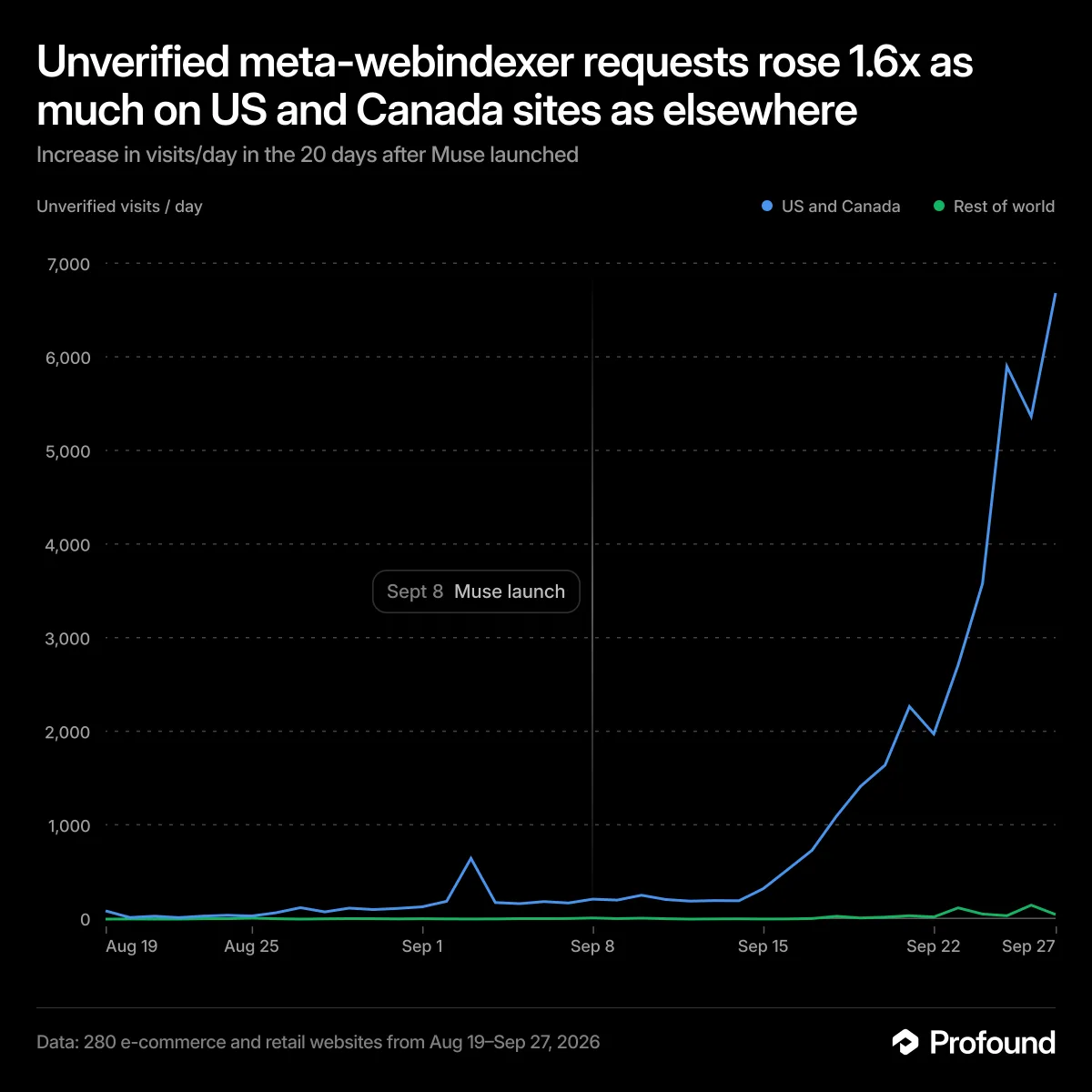
Profound calls the figure only a proxy for Muse traffic, and it excluded 15 high-volume domains that showed signs of automated activity. Its own conclusion is that measuring how a website influences these agents’ choices will need signals other than citations.
Recap
What did Profound find about Muse’s shopping recommendations?

In 50 prompts from one retail category, Muse typically recommended six products: four found by browsing merchant websites and two from Meta’s product catalog, even though the catalog returned roughly 60 candidates per prompt. Profound calls the sample small and exploratory.
How does Muse search for products?
Muse checks the shopper’s profile for recorded preferences, then searches merchant websites in a browser and queries a Meta product catalog at the same time. It reads pages through the browser’s accessibility tree, then filters and ranks the combined candidates.
What does this change for merchants?
Being in Meta’s product catalog gets a product considered, but on Profound’s figures the pages Muse opens itself supply most of what it recommends. Because Muse browses as an ordinary visitor and names no sources, merchants cannot easily see when it has read their pages.