








Walmart is letting third-party AI agents shop Walmart and Sam’s Club for its customers, and has published the rules those agents must follow to do it. The retailer set out three pieces in a post on its newsroom on 21 October: Agent Profiles, the Walmart Agent Gateway and a set of terms for AI agents.
The announcement puts Walmart on the opposite side from its largest competitor. From 21 September, Amazon blocked Meta’s Muse agent from shopping Amazon.com, telling users that an unauthorized AI agent violates its Conditions of Use. Walmart already works with Muse, and with ChatGPT and Gemini through its Sparky assistant.
It is also a step further than Walmart went in March, when it moved to Sparky on ChatGPT after calling sales through ChatGPT’s Instant Checkout disappointing. That plan kept the purchase on Walmart’s own site. This one lets the agent buy, but inside a customer account that Walmart controls.
How Agent Profiles Work
Today, an agent shopping for someone signs in with that customer’s own account, so its purchases are mixed in with everything else. Agent Profiles give each agent a dedicated profile inside the account, and the customer sees the agent’s orders separately.
Customers choose how purchases get approved. They can require approval for every order, or let the agent buy within a spending limit they set. Walmart gives $50, $100 or $200 as examples. A profile can be switched off at any time.
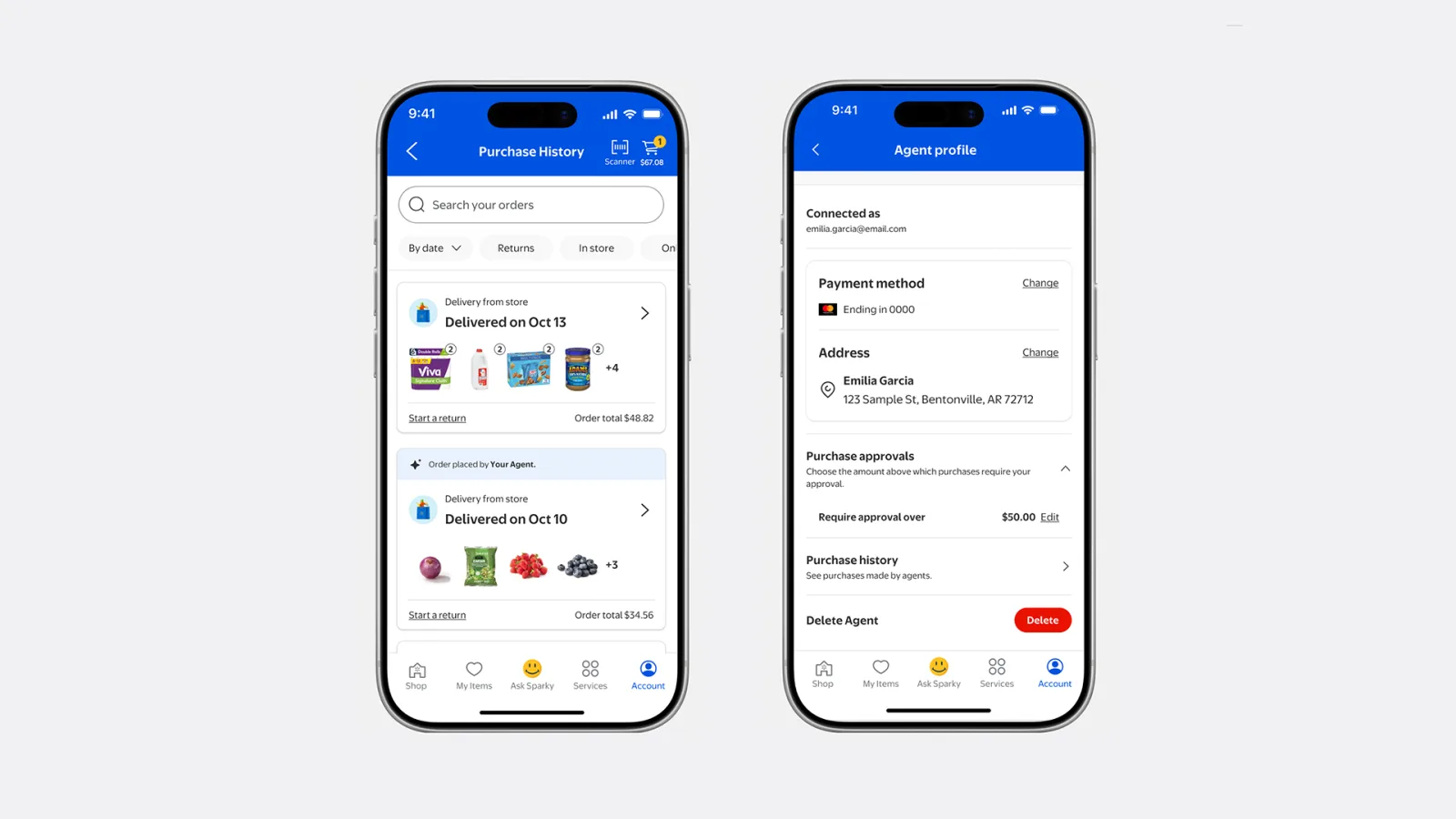
Walmart says Agent Profiles launch “in the next month”. According to TechCrunch, a profile is created the first time a customer shops with a given agent through the Gateway, and any Walmart account can use one without a Walmart+ membership.
Walmart also says agents will see the same prices as people. “We price products, not people,” the post reads, so an agent sees the prices shown on Walmart.com, with offers and fees shown before purchase.
The Agent Gateway Starts as a Beta
Agents that shop Walmart today do it through a web browser, following steps built for people. Walmart says that process is slow and error-prone. The Agent Gateway gives agents a direct connection instead, using the Model Context Protocol (MCP), the standard Anthropic created for connecting AI agents to outside tools and data.
It is not open to everyone yet. Walmart says it will begin with a beta for companies and developers, and the post gives no date for a wider release.
The Gateway also handles a customer’s regular items. If someone tends to buy a particular sourdough bread or brand of milk, Walmart will help the agent find those items without sharing the customer’s wider purchase history with it.
The Rules Agents Must Follow
The terms set limits on the agent rather than the shopper. Customers must approve agent purchases by default, and Walmart may ask for extra approval even on orders inside a spending limit. Agents must not act beyond what the shopper intends, and they can only reach the information a task needs and the customer allows.
Agents never receive card details and cannot add or change a payment method. Walmart’s returns process applies even when an agent does not act as intended. Agents that break the terms will be blocked from the site.
The terms also say where data goes. Whatever a customer shares with an agent falls under that agent’s own privacy policy, not Walmart’s. Walmart’s Privacy Notice covers only what the agent passes to Walmart.
Two Retailers, Two Answers to Agents
Walmart is not the only large seller opening up over MCP. In October, Shopify opened its catalog and checkout to any agent that connects to its Shop MCP server. Amazon has gone the other way, and one of its complaints about Muse was that the agent does not identify itself while browsing.
 Walmart
 Amazon
 Shopify
Agent Profiles answer that complaint from inside the store. Each agent shops under its own profile, its orders are kept apart from the customer’s, and an agent that ignores the rules can be shut out.
For brands selling at Walmart, the Gateway changes who chooses the product. When an agent asks for a customer’s usual items, Walmart finds them from its own records and keeps the purchase history to itself. The open question since Meta’s Muse launch, what an agent relies on to pick a product, has a partial answer at Walmart. For a customer’s regular shop, Walmart supplies it.
Recap
What has Walmart announced for AI shopping agents?

Walmart is introducing Agent Profiles, the Walmart Agent Gateway and a set of terms for AI agents. Together they let customers shop Walmart and Sam’s Club through third-party agents, with permissions and controls Walmart sets.
How do Agent Profiles control what an agent can buy?
Each agent gets its own profile inside the customer’s Walmart account, so its orders show separately. The customer either approves every purchase or sets a spending limit, and can switch the profile off at any time.
What changes for shoppers and brands when agents shop at Walmart?
Agents see the same prices as people, never receive card details, and are blocked if they break Walmart’s terms. When an agent asks for a customer’s usual items, Walmart finds them without handing over the purchase history.