







ChatGPT ads pilot is now live in the United Kingdom, OpenAI's first market outside North America and Australasia. The expansion was confirmed on LinkedIn by Benji Shomair, OpenAI's VP of Monetization, and by Global Head of Ads David Dugan, who named Zalando as a launch partner.
This move follows a gradual rollout pattern that started in the U.S. in February, when ChatGPT ads were first introduced to a limited set of users. After that, the pilot was extended in March to Australia, New Zealand, and Canada. The UK is the next market in that sequence, suggesting OpenAI is still operating with a controlled rollout approach rather than a broad release. Dentsu has separately confirmed that its clients are in the pilot.
What the Format is and How it Works
ChatGPT ads appear as clickable sponsored links placed beneath the AI-generated answer, matched contextually to the conversation. OpenAI says ads do not influence the answers ChatGPT gives users.
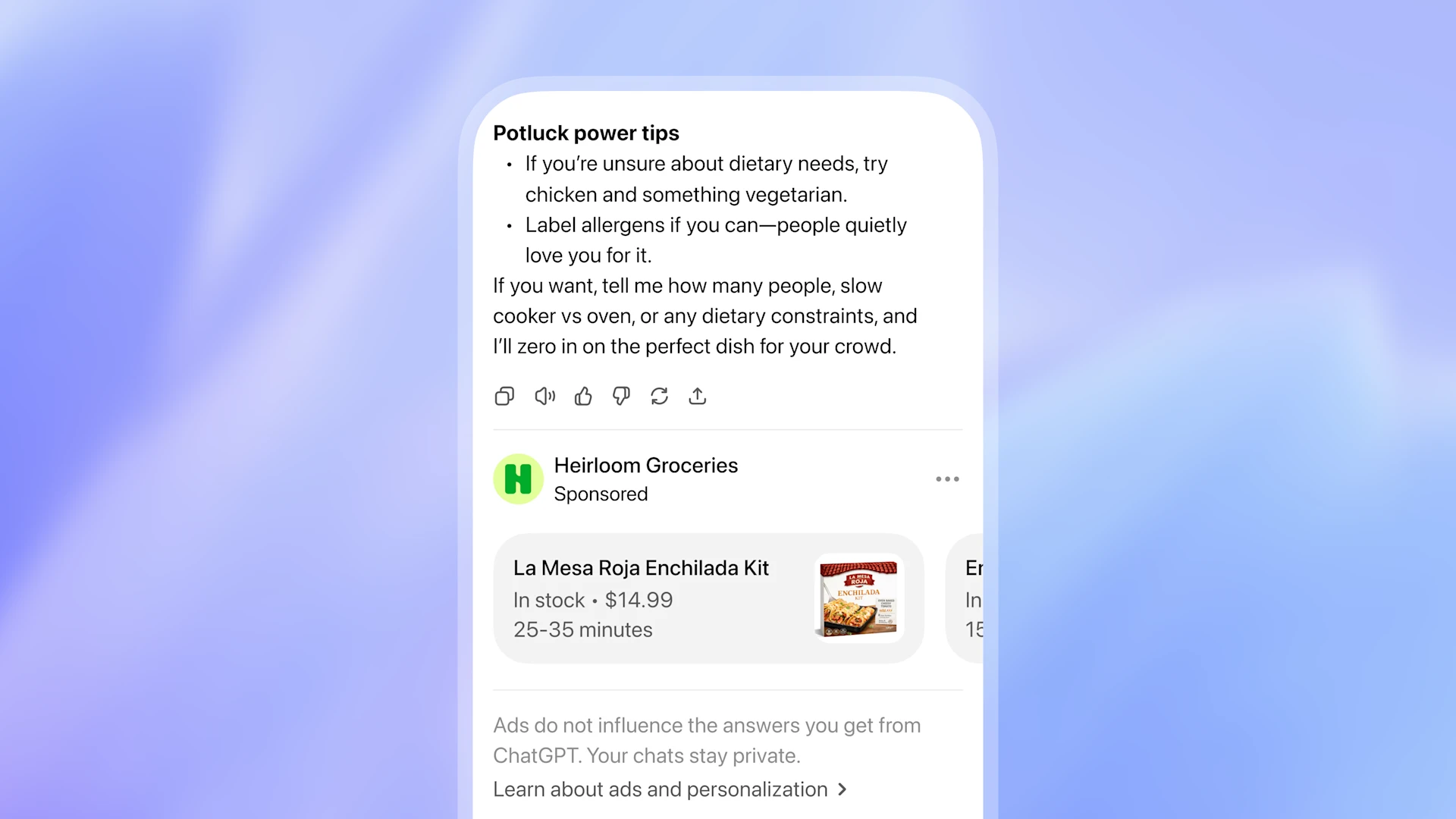
Placements only reach users on the free and Go subscription tiers. Plus, Pro, Business, Enterprise, and Education users do not see ads. According to the company, targeting works through a free-text "context hints" field rather than a keyword auction. Advertisers describe the topics, conversations, or scenarios where they want their product to surface, and OpenAI's ad ranking selects when to show it.
The Gap UK Advertisers Need to Understand
A market going live for consumers is not the same as a market being open for advertisers to buy into. Consumer-side availability does not mean self-serve access. In the U.S., those milestones were three months apart. Consumer ads launched in February and OpenAI's self-serve Ads Manager, which lets marketers run, monitor, and optimize campaigns without going through OpenAI sales, opened to all U.S. advertisers in early May.
The UK consumer pilot is now live. However, OpenAI has not announced when self-serve access will be available for UK-based advertisers. UK-domiciled advertisers can register interest at openai.com/advertisers, but the only buy path right now runs through an OpenAI rep. Advertisers weighing the channel can review how ChatGPT ads are priced and bought before committing budget.
On CPMs, UK CPMs have not been published. U.S. pricing has shifted since launch, with OpenAI moving from CPM-only to CPC bidding in May at roughly $3 to $5 per click. Measurement and buying tools have also been landing in sequence. Conversion tracking shipped in May, CPA bidding entered early access on June 5, and daily budget caps reportedly shipped last week. Those are the milestones that turn the pilot from a managed beta into a measurable channel.
Why OpenAI is Moving This Fast
The UK go-live sits inside a near-daily build-out of OpenAI's ad infrastructure. OpenAI has publicly projected $2.5 billion in advertising revenue for 2026, rising to $102 billion by 2030, and says the ads business crossed $100 million in annualized revenue six weeks after the U.S. consumer launch.
An ads business that is barely four months old needs more advertisers, in more markets, quickly. That revenue pressure explains the pace of geographic expansion.
It also explains the tension that comes with it. ChatGPT conversations are more personal than anything Google or Meta built an ad business on. People use it to work through medical decisions, financial anxieties, and relationship problems. The data that makes those conversations commercially valuable is the same data that makes exploiting them a reputational and regulatory risk at scale. OpenAI has maintained an "ads don't change answers" principle through the pilot. Whether that holds under full commercial pressure, and at the scale of a global ad market, is an open question.
The UK-specific Regulatory Angle
The U.S. pilot operated within a relatively permissive regulatory environment for AI-powered ad targeting. The UK is different.
The UK is OpenAI's first European-regulated market in the pilot, which activates the company's updated EU advertising policy. The policy ties personalized ads in the Free and Go tiers to explicit user consent rather than the broader "legitimate interest" basis. Consenting users receive personalized ads informed by past chats, memory, ad history, and advertiser-supplied data. Non-consenters see contextual ads only, drawn from location, time of day, and the current conversation context.
The ICO's guidance on profiling and the UK's consumer protection rules will interact with the personalization signals OpenAI is using for ad matching in ways that have not yet been tested or clarified. How the ICO interprets the use of past chat content and ChatGPT "memory" as targeting inputs has not been tested in a US-only pilot. UK consent rates and the practical operation of the consent flow are the signals to watch as the rollout settles.
Recap
What is the ChatGPT ads pilot, and where is it available?

OpenAI's ChatGPT ads pilot places sponsored, clearly labelled links beneath AI-generated answers for users on the Free and Go subscription tiers. The United Kingdom is now part of the pilot alongside the United States, Australia, New Zealand, and Canada. Plus, Pro, Business, Enterprise, and Edu subscribers continue to see no advertising.
How can a UK advertiser buy ChatGPT ads right now?
UK-domiciled advertisers can register interest at openai.com/advertisers and work directly with an OpenAI representative. OpenAI's self-serve Ads Manager remains US-only, although the United Kingdom is bookable as a geo option from inside the US tool, which lets advertisers with a US entity or partner buy UK inventory through self-serve today.
What does the UK launch mean for OpenAI's broader ad rollout?
The United Kingdom is OpenAI's first European-regulated test market, which activates the company's updated EU advertising policy and its consent-based personalisation requirement. OpenAI has named Japan, South Korea, Brazil, and Mexico as the next markets in the rollout.