








ChatGPT now has 900 million weekly active users, according to OpenAI, a figure that has more than doubled in twelve months. For most of that run, OpenAI had a clear position on advertising: it was not happening. Sam Altman had said publicly that he did not want to build a business model around ads. The company was betting on subscriptions, API revenue, and enterprise contracts to fund what it was building.
That position did not hold.
In February 2026, ads arrived in ChatGPT, initially limited to a select group of enterprise brands, priced at a $200,000 minimum entry and a $60 CPM that put it out of reach for most performance budgets. In the months since, the pricing has been rebuilt almost entirely. The minimums are gone. CPC has arrived. And reports indicate CPA bidding is now being tested with select advertisers.
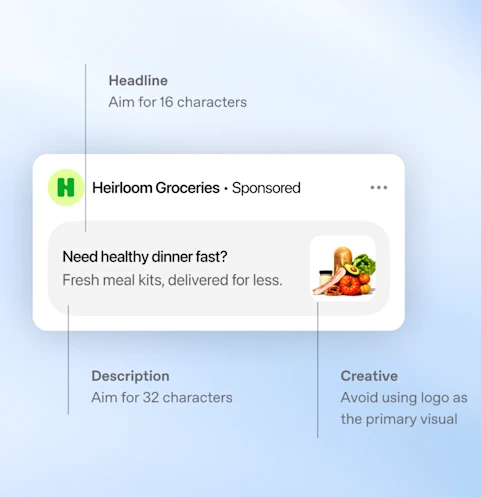
What has emerged is not a single price for advertising inside ChatGPT, but a system that allows advertisers to choose how they want to pay depending on what they are trying to achieve. In simple terms, ChatGPT ads pricing is built around an auction where advertisers compete for placement, and the final cost is determined dynamically based on demand, targeting, and relevance. Instead of a fixed rate card, the system adjusts in real time, meaning two advertisers targeting similar audiences can end up paying different amounts depending on competition and campaign setup.
Within that auction system, pricing is structured around two primary models that are currently confirmed by OpenAI: CPM and CPC.
How it started: CPM, $200,000 minimums, and a closed door
When ChatGPT ads launched, the access model was deliberate. OpenAI was not opening a self-serve auction to the market. It was running a controlled pilot with a small group of enterprise brands, including Adobe, Best Buy, AT&T, and Expedia, in the U.S., Canada, Australia, and New Zealand.
The only available buying model was CPM. Every time an ad is shown, it contributes to a total impression count, and advertisers are charged once that count reaches a thousand.
Under this model, advertisers pay for impressions, with a default max bid of $60 per 1,000, as confirmed in OpenAI’s Help Center documentation. At a $200,000 minimum commitment, that is a brand awareness buy. Performance marketers had no meaningful way in, and for the most part, were not the intended audience yet.
That combination, a premium CPM and a six-figure floor, meant brands were not just committing a large budget. They were paying for an unproven placement on a platform with no performance track record, no industry benchmarks, and at the time, no reliable way to verify whether any of those impressions did anything at all. How that $60 figure actually stacks up against what reach costs elsewhere is worth its own look later in this piece.
The measurement infrastructure reflected the same early-stage reality. There was no tracking pixel, no post-click attribution, no standard conversion tracking. Performance data came through weekly CSV files. For a channel positioning itself as a premium placement, the reporting tools were basic.
The early results were uneven. The Keyword reported in March that a technical glitch had blocked advertisers from viewing their own campaign performance data inside Ads Manager, and that one enterprise advertiser had spent just 3% of a $250,000 budget over several weeks with no visibility into whether any of it had worked. Data from Adthena put ChatGPT’s click-through rate at 0.91%, against 6.4% on Google Search. OpenAI described the rollout as iterative. The results in those first weeks suggested it needed to be.
“The CPM-only model made sense as a starting point. You need to establish inventory value before you open performance buying,” says one media director at an independent agency who monitored the pilot closely. “But at $60 CPM with a $200K floor, the only advertisers who could participate were the ones with the budget to treat it as an experiment. That is a small pool.”
The shift that changed everything: CPC arrives in April
In April 2026, OpenAI activated cost-per-click buying inside ChatGPT. CPC shifts pricing from visibility to interaction. Advertisers are only charged when a user clicks on an ad, making spend more directly tied to engagement outcomes.
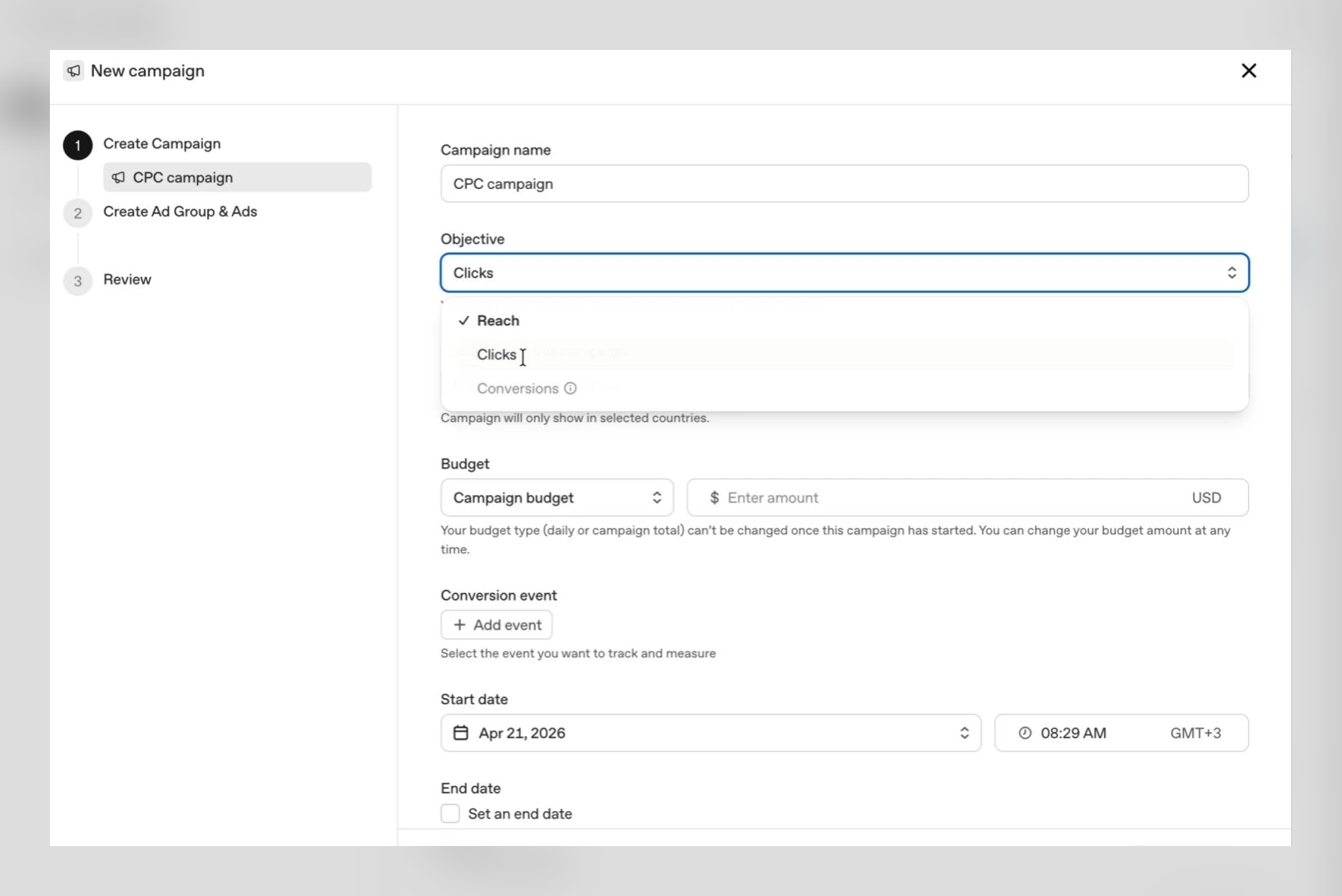
Under CPC, advertisers pay only when a user clicks their ad, not for the impressions served to get there. OpenAI recommends a starting max bid of $3–$5 per click, as stated in its official documentation. The minimum spend dropped alongside the CPC launch, first to $50,000, then removed entirely when the self-serve Ads Manager Beta opened to all U.S. advertisers in May.
At those confirmed rates, here is what a CPC campaign looks like at different click volumes:
- 500 clicks at $3 CPC = $1,500 / at $5 CPC = $2,500
- 1,000 clicks at $3 CPC = $3,000 / at $5 CPC = $5,000
- 5,000 clicks at $3 CPC = $15,000 / at $5 CPC = $25,000
- 10,000 clicks at $3 CPC = $30,000 / at $5 CPC = $50,000
The $3–$5 range puts ChatGPT CPC broadly in line with Google Search for general categories. That is the comparison that matters most for performance teams evaluating whether the channel is worth a test budget.
CPM is a model built for reach and brand exposure. CPC is a model built for accountability. You pay for traffic, you measure what that traffic does, and you optimize from there. The arrival of CPC moved ChatGPT from a channel performance teams were watching from a distance to one they can now actually justify testing.
“CPC is what made this worth a real conversation internally,” says a paid search lead at a mid-size DTC brand. “At $3–$5 a click, the question becomes whether the intent behind that click converts at a rate that makes the economics work. That is a question we know how to answer. $60 CPM with no pixel and no conversion data is not.”
Around the same time, OpenAI’s self-serve Ads Manager interface surfaced in testing, showing a campaign structure of Campaigns, Ad Groups, and Ads that performance buyers would recognize immediately from Google Ads and Meta. The interface was not yet public, but its appearance signalled the direction OpenAI was building toward.
CPA bidding: what the reports say
OpenAI officially supports two buying models: CPM and CPC. A third, cost-per-action, is a different proposition entirely.
Under CPA, advertisers pay only when a user completes a defined conversion event: a sign-up, a purchase, a lead submission. The platform absorbs the cost of impressions and clicks that do not lead to that outcome and recovers only on completed actions. It is the most performance-aligned model of the three, and the one that most closely mirrors how mature platforms like Google and Meta price performance outcomes.
Last week, the Keyword reported that CPA bidding had entered pilot testing with a select group of advertisers. Access is gated on having conversion tracking active through the OpenAI pixel or Conversions API. OpenAI has not confirmed CPA pricing publicly, and the model has not yet appeared in its official Help Center documentation.
However, what CPA bidding signals if it moves beyond pilot, is the direction OpenAI is building toward. CPM attracts brand advertisers. CPC attracts performance teams willing to carry conversion risk. CPA shifts that risk back to the platform and is the model that would make ChatGPT ads directly comparable to the performance infrastructure advertisers already rely on from Google and Meta.
How ChatGPT ad pricing compares to other platforms
On a CPC basis, OpenAI's confirmed starting bid of $3 to $5 puts ChatGPT roughly in line with Google Search for general categories. That comparison holds up because both are pricing the same unit: a click.
On a CPM basis, the comparison runs against a different set of platforms like YouTube, Meta, and Netflix which sell CPM. Industry benchmark estimates compiled from agency and analyst data shows that YouTube's average CPM runs roughly $5 to $10 for most advertisers, with premium in-stream and connected TV placements closer to $11 to $18. Meta's average CPM across industries sits around $11 to $14, having risen sharply over the past year as auction competition increased.
Netflix sits highest among the three, with programmatic inventory estimated at $20 to $30 CPM and direct insertion orders running $45 to $65, reflecting its lighter ad load and premium content environment.
Against that range, ChatGPT's $60 default CPM is more expensive than YouTube and Meta, and lands closer to Netflix's direct-buy premium tier.
But the gap between those numbers tells you less than it appears to, because none of these platforms are selling the same thing. YouTube and Meta sell scale. Their CPM reflects video and feed impressions served at volume, with years of brand-lift and conversion data behind every figure, and a known answer to what a good outcome looks like in nearly every industry. Netflix sells attention inside long-form content that a subscriber chose to watch, at a deliberately light ad load, which is why its $45 to $65 direct-buy range has stood up against competition from cheaper platforms.
ChatGPT is selling something with no real precedent: a single ad shown to a single person inside a live, one-to-one conversation, with four months of history and no published industry benchmark for what a good outcome looks like.
So the comparison cuts two ways. ChatGPT is more expensive than YouTube and Meta and priced like Netflix's premium tier. But Netflix's price is backed by a decade of TV-grade measurement that tells advertisers exactly what they are getting for it. ChatGPT is asking for a similar price on a format that does not yet have that proof behind it.
There is a second distortion in the raw numbers worth naming. Netflix's $45 to $65 is a negotiated price for a guaranteed placement. ChatGPT's $60 is a self-set ceiling inside a second-price auction, which means most advertisers are not paying anywhere close to $60. The two figures are not even structurally the same kind of price, which is part of why a side-by-side number comparison flatters neither platform.
Whether ChatGPT's positioning is earned depends on a question the data has not yet fully answered: does the intent signal in a live conversation, where a user is actively working through a decision, produce better post-click outcomes than the reach these other platforms sell with a much longer track record behind the price?
The early CTR data suggests caution. A 0.91% CTR against 6.4% on Google Search is a meaningful gap. But CTR and conversion rate are separate questions, and the measurement tools to answer the conversion question properly have only been in place since May. The honest answer is that the performance comparison is still being written.
How the ChatGPT ads auction works
Both CPM and CPC campaigns run through the same system: a relevance-weighted, second-price auction.
Second-price means the winning bidder pays just above the next-highest bid, not their full ceiling. Set a $5 max CPC bid and win against a competitor bidding $3.20, and you pay $3.21.
Relevance-weighted means the bid is not the only factor. The auction evaluates the match between an ad and the conversation it is being considered for. OpenAI’s system weighs four things:
- Context hints: plain-language descriptions advertisers provide about when and where their ads should appear, in place of keyword or demographic targeting
- Ad copy and title: how well the message matches the user’s conversational context
- Landing page relevance: whether the destination aligns with what the user was asking
- Competition: how many other advertisers are targeting the same conversation context at the same time
The process begins when ChatGPT identifies that a conversation may support a commercial placement. OpenAI describes these ads as being shown in context, meaning eligibility is based on the content and direction of the conversation rather than a traditional keyword search query. Once a potential ad opportunity is identified, eligible advertisers who meet the targeting and campaign conditions are entered into an auction in real time.
Each advertiser submits a bid based on their selected pricing model. In a CPM campaign, the bid reflects how much the advertiser is willing to pay for 1,000 impressions. In a CPC campaign, it reflects how much they are willing to pay each time a user clicks on the ad.
The winning advertiser is not determined by bid alone. OpenAI describes the auction as being influenced by relevance signals. The system also evaluates how appropriate an ad is for the conversation context and how likely it is to generate engagement. In effect, advertisers are not only competing on price but also on how well their message fits the inferred intent of the user at that moment.
The selected ad is then displayed as a clearly labeled sponsored message separate from ChatGPT’s generated response. OpenAI has emphasized that ads do not influence the model’s answer itself, and are served through a distinct ad layer within the interface.
Once the ad is served, billing follows the chosen pricing model. This structure places ChatGPT’s advertising system within the broader family of auction-based digital ad platforms, but with a key difference in how inventory is created.
An advertiser with a lower bid but stronger relevance signals can outrank a higher bidder with a poor ad-to-context match. The implication is, writing precise context hints and building ads for specific use cases matters as much as setting a competitive bid. Generic brand messages built for a display environment will not perform well in a relevance-weighted conversational auction.
Understanding how these models work is key to understanding what ChatGPT ads actually represent today. In CPM campaigns, advertisers are buying scale, paying to ensure their message appears within ChatGPT responses a certain number of times. In CPC campaigns, they are buying traffic, paying only when users actively engage. Both run through the same auction system, which means pricing is not fixed but determined by how much other advertisers are willing to pay for similar audiences at the same time.
What drives your actual cost
Beyond the auction mechanics, several factors shape what a ChatGPT campaign costs to run in practice.
Campaign objective. CPM and CPC carry different risk profiles. Under CPM, the advertiser pays for exposure regardless of outcome. Under CPC, they pay for engagement but carry the conversion risk themselves. If clicks do not convert, the cost is real but the return is not. Understanding which objective matches your campaign goal matters before setting a bid.
Context hint quality. ChatGPT ads do not use keyword targeting or demographic segments. Advertisers describe the conversations where their ads should appear in plain language. Vague or overly broad context hints produce weak relevance scores and worse auction outcomes.
Inventory constraints. Ads reach only users on ChatGPT’s Free and Go tiers. Users on Plus ($20/month), Pro ($200/month), Business, Enterprise, and Education plans see no ads. The most engaged and highest-spending ChatGPT users are disproportionately on paid plans, which constrains the addressable audience in ways that matter for targeting assumptions.
Topic exclusions. Ads do not appear near health, mental health, or political content. Advertisers in adjacent categories need to account for these exclusions when estimating reach and planning creative.
Geography. Self-serve access is currently live for U.S. advertisers. The UK joined last week. Pricing dynamics in newer markets may differ as inventory and competition levels vary.
What is still unknown
ChatGPT ads have moved fast. Several things remain genuinely unresolved.
What makes the pricing evolution significant is not just the introduction of multiple models, but the direction of travel. Industry analysts often describe early-stage advertising platforms as moving through a familiar sequence: starting with attention-based pricing, shifting toward engagement-based models, and eventually incorporating outcome-based measurement. ChatGPT is moving through that sequence quickly, even if not all stages are fully mature or formally productized.
The system is still early, and that limitation matters. Unlike Google or Meta, which have years of performance data across industries and campaign types, ChatGPT does not yet have established benchmarks for what advertisers should expect in terms of conversion rates, cost efficiency, or return on spend. That absence of historical data means advertisers can run campaigns today, but they are operating in a calibration phase rather than an optimization phase. The tools exist. The predictability has not yet formed.
This creates a specific kind of uncertainty. It is not uncertainty about whether ads can be run, but uncertainty about how they will perform at scale. Advertisers can choose between CPM and CPC, set budgets, and measure engagement, but they cannot yet rely on stable industry-wide benchmarks that tell them what good looks like inside ChatGPT as a media channel.
CPA pricing: OpenAI has not confirmed what CPA campaigns will cost when the model exits pilot. Until it does, advertisers cannot fully model the economics of outcome-based buying on the platform.
Conversion quality at scale:The argument for ChatGPT ads rests on intent quality. The idea is that a user mid-conversation is a better prospect than a user mid-scroll. That argument is plausible. It has not been independently verified across a meaningful sample of advertisers and verticals with reliable attribution data.
Auction maturity: The system is four months old. Clearing prices, competition levels, and how the relevance algorithm weights different signals will continue to evolve as more advertisers enter. What it costs to win a relevant placement today may look different by the end of the year.
International dynamics: Self-serve is live in the U.S. and expanding. Pricing in newer markets will depend on local inventory depth and advertiser competition, neither of which is established yet.
The bottom line
ChatGPT ads pricing is confirmed by OpenAI at a $60 default CPM and a recommended $3–$5 CPC starting bid, running through a relevance-weighted second-price auction. A third model, CPA, is in reported pilot testing with pricing not yet confirmed.
The trajectory from a $200,000 minimum CPM-only buy to a self-serve multi-model auction with no minimum spend happened in four months. That pace reflects both the commercial pressure OpenAI is under and a deliberate build toward a performance ad system rather than a premium media placement.
For performance marketers, the access question has been answered and the pricing benchmarks are now clear enough to plan a test. What has not been answered is whether ChatGPT’s intent signal translates into the conversion outcomes that would make it a permanent line in the media plan rather than an experiment.
Recap
How much do ChatGPT ads cost?

OpenAI confirms two pricing models. CPM campaigns carry a default max bid of $60 per 1,000 impressions. CPC campaigns have a recommended starting bid of $3–$5 per click. What you actually pay depends on the auction, not the ceiling you set.
What is the difference between CPM and CPC on ChatGPT?
CPM charges for every 1,000 impressions served, regardless of clicks. CPC charges only when a user clicks the ad. CPM suits brand awareness goals. CPC suits performance buyers who need to spend tied to engagement.
How does ChatGPT ad pricing work?
ChatGPT uses a relevance-weighted, second-price auction. Advertisers compete for placement in conversations, and the winner pays just above the second-highest bid. Relevance, not just spend, determines who wins.

 Free tool · Meta Ad Library