


Virtual assistant services provide remote administrative, creative, or technical support through human contractors, managed agencies, or AI tools, helping teams offload routine work while focusing on revenue-generating activities. Market estimates range from approximately $3.07 billion in 2024 to broader estimates near $28.7 billion for 2025, so buyers should calculate workflow costs instead of trusting a headline figure.
The popular advice is simple: find the lowest hourly rate and delegate everything repetitive. That advice fails when coordination time, timezone overlap, security reviews, unclear ownership, and rework consume the savings. A capable assistant can increase team capacity, but only when the work is defined, access is controlled, and the fully loaded cost is visible.
Table of Contents
- Performance marketing monitoring
- E-commerce catalog operations
- B2B SaaS competitive intelligence
- Sample marketing VA job description
- Contract language to adapt
What Virtual Assistant Services Actually Are
Virtual assistant services are remote support arrangements in which a human contractor, managed agency, or software system handles defined administrative, creative, marketing, or technical work. The assistant might manage a calendar, format content, update a CRM, monitor advertising campaigns, prepare research, or route customer inquiries. The arrangement can be flexible, but the responsibilities still need to be explicit.
The category is broader than many buyers assume. One industry estimate values the global virtual assistant service market at approximately $3.07 billion in 2024 and projects it to reach about $10 billion by 2035, with administrative assistance representing roughly $1.02 billion in 2024 and a projected $3 billion by 2035. A separate estimate places the broader market at $2.0545 billion in 2021 and projects $8.6135 billion by 2028. These figures come from different definitions of the category, as outlined in this virtual assistant service market estimate.

Why market numbers disagree
One report might count dedicated VA companies and agencies. Another might include freelance platforms, offshore outsourcing, customer support, AI assistant software, implementation work, or consumer voice assistants. Those are different markets with different cost structures, so their totals shouldn't be used interchangeably.
The distinction matters during vendor selection. A company comparing an agency retainer with an AI subscription isn't comparing equivalent products. The agency may include recruitment, supervision, replacement coverage, payroll administration, and quality control. The software may automate a narrow workflow but leave setup, exceptions, security, and human review with the buyer.
Practical rule: Define the work model before comparing prices. A freelancer, managed service, and AI tool solve different operational problems.
Three operating models
Independent human VAs work directly with the client, usually under an hourly, retainer, project, or task arrangement. This model offers direct communication and can work well when a manager has time to train, review, and supervise the assistant.
Managed VA agencies provide a layer of recruiting, matching, oversight, scheduling, and replacement support. They can suit teams that need continuity or don't want to manage international contracting, but the service fee may include responsibilities that a direct hire would leave with the client.
AI-assisted platforms automate repeatable actions such as classification, drafting, data entry, procedural guidance, and reporting, sometimes with human review. They're useful where rules are clear and source data is structured. They're weaker when the workflow depends on judgment, ambiguous context, or irreversible decisions.
The right choice starts with the task, not the vendor. A routine calendar workflow may fit automation or a generalist. Sensitive customer records, complex campaign decisions, and nuanced executive support usually need accountable human judgment.
Types of Virtual Assistant Services
Administrative assistance remains the broadest category. A VA can sort an inbox, schedule meetings, prepare documents, reconcile a spreadsheet, book travel, organize shared files, or update a project board. This segment was estimated at roughly $1.02 billion in 2024, according to the market estimate cited earlier. Human judgment matters when priorities conflict, a stakeholder needs tact, or a calendar change affects several people.
Marketing and advertising support sits closer to revenue operations. A marketing VA might schedule social posts, compile campaign reports, check landing-page links, organize creative files, research audiences, or prepare basic SEO briefs. For local campaigns, the workflow may include maintaining business information and review data, with guidance such as this local listings management guide helping define the recurring checks.
Creative support includes copy editing, blog formatting, presentation design, graphic production, video trimming, podcast preparation, and newsletter assembly. Automation can resize assets or apply templates, but a human should still review brand voice, factual accuracy, accessibility, and whether a piece actually serves its audience.
AI-assisted VA workflows combine software with human review. Typical applications include CRM updates, lead classification, meeting-note summaries, report drafting, and exception detection. Automation handles predictable steps efficiently, while a person reviews missing data, unusual records, policy-sensitive content, and any action that could change a customer, payment, or advertising account.
Specialized assistants support a particular operating environment. Examples include e-commerce catalog management, podcast production, recruiting coordination, funnel building, customer support, technical SEO, and competitive intelligence. Specialization can reduce training time, but it doesn't remove the need for documented processes and access controls.
| Service type | Typical daily work | Human judgment matters most when |
|---|---|---|
| Administrative | Scheduling, inbox organization, documents, travel | Priorities conflict or communication is sensitive |
| Marketing and advertising | Reporting, campaign checks, research, publishing | Budget, audience, or message decisions change |
| Creative | Formatting, editing, design, video preparation | Brand quality and editorial standards matter |
| AI-assisted | Classification, drafting, CRM updates, exceptions | Data is incomplete or an action is irreversible |
| Specialized | E-commerce, podcasts, SEO, recruiting, funnels | Industry context affects the correct action |
A useful intake question is, “What does a completed task look like?” If the answer is vague, the service category isn't ready for outsourcing. Define the input, process, output, reviewer, deadline, and escalation path first.
Benefits and Use Cases for Marketing and Operations Teams
Remote support became more central as work moved away from traditional offices. U.S. Census-based figures cited in industry research show that the share of workers working from home rose from 5.7% in 2019 to 13.8% in 2023, while one dataset reported administrative-assistant employment declining from 2,038,340 workers in 2019 to 1,785,430 in 2023, a decrease of approximately 12.4%. The Bureau of Labor Statistics overview of secretaries and administrative assistants provides occupational context for this restructuring.
The important point isn't that administrative work vanished. Tasks moved among office employees, remote workers, contractors, and specialized providers. A marketing manager may still own campaign strategy, but a remote assistant can monitor routine checks, prepare reports, organize creative feedback, and flag anomalies before the manager's review.

Where marketing teams gain leverage
A performance team often loses time not through one difficult task, but through dozens of small interruptions. A VA can assemble daily spend and delivery checks, maintain naming conventions, prepare a list of broken links, organize creative versions, and document campaign changes. The strategist then spends less time collecting facts and more time deciding where the budget and message should go.
Customer inquiry workflows can also be split cleanly. Automation may identify the topic and draft a response, while a human assistant checks tone, account context, and escalation criteria. Teams evaluating conversational automation can use reporting about tools designed to handle purchase inquiries, including this coverage of Meta's business AI initiative.
A useful division is straightforward:
- Routine monitoring: The assistant checks defined fields and flags exceptions.
- Preparation: The assistant gathers evidence, formats reports, and organizes inputs.
- Decision-making: The strategist or operations lead approves budget, positioning, policy, and customer-impacting actions.
The value is cognitive relief as much as labor capacity. A senior marketer who no longer switches between analytics, spreadsheets, inboxes, and publishing tools can protect longer blocks for creative and commercial work.
This video can help teams think about the broader role of assistants in modern marketing operations.
Where operations teams benefit
Operations leaders commonly delegate vendor follow-ups, meeting preparation, report assembly, SOP formatting, and task coordination. The assistant doesn't replace ownership. Instead, the assistant keeps information current so the owner can act without reconstructing the workflow from scattered messages.
Virtual assistant services aren't a universal fix. They struggle when the process changes daily, the owner can't answer questions, or the assistant receives broad access without clear boundaries. Delegation works best when routine execution is separated from judgment and exceptions have a named decision-maker.
Pricing Models and Cost Benchmarks
The four common pricing structures are hourly, retainer, per-task, and outcome-based. Each creates a different risk allocation between buyer and provider.
| Pricing model | How payment works | Best fit |
|---|---|---|
| Hourly | Payment follows recorded working time | Variable workloads and exploratory pilots |
| Retainer | A recurring fee covers an agreed capacity or task bundle | Predictable recurring support |
| Per-task | Each defined deliverable has its own price | Standardized outputs with clear acceptance criteria |
| Outcome-based | Payment is tied to an agreed result | Narrow growth or performance engagements |
Hourly pricing looks transparent, but it can hide supervision. A low rate may become expensive if the client spends substantial time explaining tasks, checking work, correcting errors, attending avoidable meetings, and covering timezone gaps. A higher rate can be cheaper when the assistant works independently and produces reliable outputs.
The fully loaded cost formula
Calculate monthly cost in five parts:
- Provider cost: Hourly fees, retainer charges, task fees, or platform subscriptions.
- Coordination cost: Time spent assigning work, answering questions, attending check-ins, and clarifying ownership.
- Quality-control cost: Review time, approvals, audits, and corrections.
- Rework cost: Duplicate effort caused by errors, missing context, or rejected deliverables.
- Security and administration cost: Access reviews, credential management, contracts, compliance work, and account closure.
The result is the fully loaded monthly cost. It should be compared with the value of the productive capacity returned to the core team, not merely with the assistant's invoice.
For example, a marketing lead might regain time previously spent assembling campaign reports. That reclaimed time only creates economic value if the lead uses it for strategy, creative development, sales support, or another activity with a clear business contribution. Time that just becomes additional meetings isn't a break-even benefit.
The cheapest hourly rate is only cheap when the workflow stays cheap to manage.
Timezone overlap deserves its own line item. A large time difference may support asynchronous production, but it can also delay approvals and create overnight rework. Buyers should specify required overlap, response expectations, and the consequences of missed handoffs before signing.
How LatHire Can Help
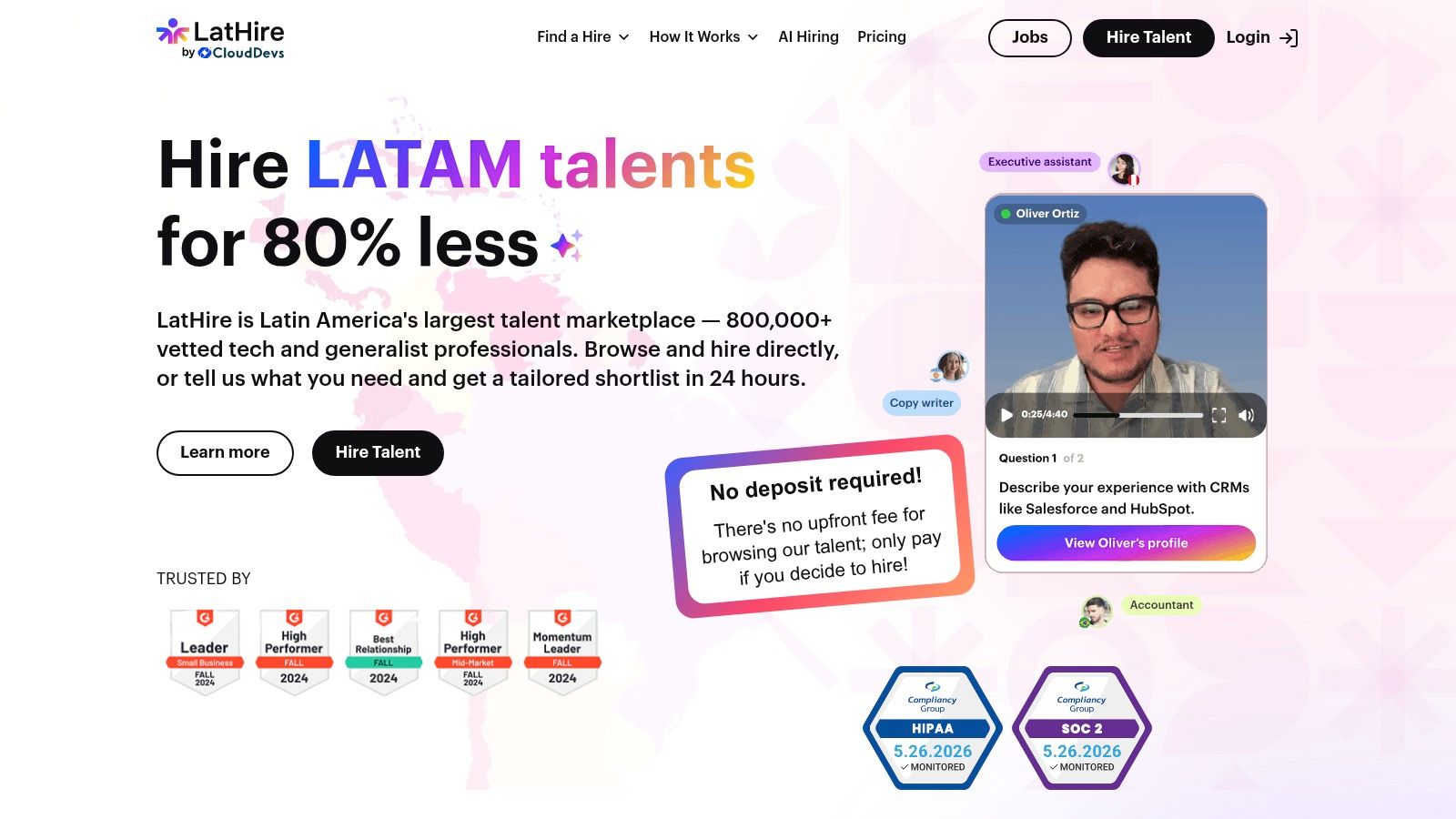
LatHire connects U.S. and Canadian companies with pre-vetted Latin American professionals across technology, marketing, sales, and operations. Its model is relevant when a buyer needs a human assistant with regional timezone alignment but doesn't want to manage every stage of international recruitment independently.
The platform uses AI assessments, skills evaluations, and human-led background checks to curate a talent pool described as containing more than 800,000 candidates. Businesses can import a job description or generate one with AI, receive candidate matches as quickly as 24 hours, and access support covering HR, international payroll, benefits, and legal compliance. LatHire also describes potential hiring-cost reductions of up to 80% and time-to-hire reductions of more than 80%. Those figures are platform claims, so buyers should validate the relevant assumptions, role scope, and contract structure before using them in a business case.
When the model fits
LatHire is worth evaluating when the role requires consistent human ownership, recurring collaboration, and a skill profile more specific than basic administration. Examples include customer support, recruiting coordination, marketing operations, administrative assistance, UX/UI work, DevOps, and AI engineering. Buyers seeking virtual assistants can use the platform as a route to a broader managed hiring process rather than treating it as a simple task marketplace.
A practical evaluation should still include:
- Role definition: List recurring tasks, tools, approval rights, and escalation rules.
- Candidate validation: Test the actual workflow, not just general communication ability.
- Availability: Confirm working hours and timezone overlap in writing.
- Compliance: Review payroll, benefits, legal, confidentiality, and data-handling responsibilities.
- Pilot terms: Establish deliverables, review points, replacement terms, and termination rights.
The strongest fit is a team that wants a durable remote role and needs help with cross-border administration. A small, occasional task may be better served by a freelancer or specialized service. A highly repetitive, rule-based workflow may justify testing AI before committing to a human hire.
How to Evaluate and Hire Virtual Assistant Services
Vendor selection should begin with the operating model. A direct freelancer offers closeness and flexibility, but the client usually owns vetting, backup coverage, contracts, and supervision. A managed agency adds structure and replacement support, while an AI-enabled provider may automate execution but still require human oversight for exceptions.
The proposal should answer practical questions, not just list services. Who assigns tasks? Who checks quality? What happens when the assistant is unavailable? Which tools are included? How much overlap is guaranteed? What work falls outside the agreed scope?
Contract terms that prevent friction
A useful agreement covers:
- Scope of work: Named tasks, exclusions, deliverables, and approval responsibilities.
- Service levels: Expected response windows, meeting cadence, availability, and escalation rules.
- Data handling: Approved systems, retention, deletion, credential use, and incident notification.
- Intellectual property: Ownership of documents, designs, copy, recordings, and process materials.
- Termination: Notice, final payments, handover duties, access revocation, and return or deletion of data.
Security deserves technical specificity, particularly when an AI-enabled service touches customer, employee, marketing, or financial information. An evaluation of eight widely used voice assistants identified weaknesses including missing or weak encryption, inadequate SSL certificate validation, insecure communications, unsafe SQL query execution, and poor information-management practices, as documented in this security evaluation of voice assistants.
Require TLS-protected communications, encryption at rest using a modern scheme such as AES-256, multi-factor authentication, role-based access controls, and audit logging. Human assistants need the same discipline through least-privilege accounts, client-specific credentials, approved storage, and rapid access revocation when the engagement ends.
A controlled onboarding sequence
Discovery and task mapping comes first. Document the current workflow, inputs, decisions, tools, owners, failure modes, and definition of done. Separate low-risk scheduling or research permissions from high-risk access to advertising platforms, payment systems, customer records, and proprietary analytics.
The pilot should use a real but bounded workflow with explicit success criteria. Measure accuracy, timeliness, communication quality, and the number of corrections required. Don't begin with the most sensitive process or the workflow nobody has documented.
Full rollout follows only after the assistant can complete the pilot reliably. Use weekly check-ins initially, keep a decision log, and update SOPs whenever the assistant encounters an exception.
Ongoing review should examine results, access rights, workload, rework, and whether the role has expanded beyond the contract.
Red flags include vague proposals, pressure to grant broad access immediately, resistance to a security review, unclear replacement terms, missing client references, and promises that don't define what successful delivery means.
KPIs, Workflows, and Tool Stacks
A VA workflow needs more than a completed-task count. A fast assistant who creates rework can cost more than a slower assistant whose outputs are consistently usable. The performance dashboard should track task success rate, step-error rate, completion time, escalation rate, and rework frequency.
A human-in-the-loop evaluation found a 70% Macro Success Rate with AI guidance, compared with 20% for unassisted guidance and 28.57% with paper instructions. The AI condition also produced a 16.43% Step Error Rate, versus 38.75% without assistance and 18.37% with paper instructions. However, AI-guided tasks averaged 186.54 seconds, showing that greater correctness doesn't automatically produce faster handling. The findings are reported in this evaluation of AI-guided task performance.
A workflow that survives handoffs
Consider a CRM update process. The assistant receives a defined source file, checks required fields, updates permitted records, labels uncertainty, and routes exceptions to the owner. The owner reviews only flagged records and samples completed work rather than inspecting every field manually.
A practical stack might include Asana or ClickUp for task ownership, Google Drive or another controlled repository for SOPs, a password manager for credentials, Slack or Microsoft Teams for communication, and the relevant CRM or advertising platform. The tool choice matters less than consistent naming, permissions, due dates, and a single source of truth.
Teams that measure marketing performance should also document how assistants contribute to attribution workflows. A resource on marketing attribution software can support that process, but the VA shouldn't be asked to interpret ambiguous revenue data without a defined owner and reporting rule.
Escalation by risk
Use automation and delegation for drafting, classification, procedural guidance, formatting, and exception detection. Require human approval for refunds, account changes, budget shifts, customer commitments, legal claims, access changes, and publishing sensitive information.
A useful escalation ticket includes the record involved, action attempted, missing information, relevant policy, deadline, and recommended next step. That structure prevents the assistant from forwarding a problem without context.
Sample success language might read: “Update assigned CRM records using the approved fields, flag missing consent data, complete the queue by the agreed deadline, and escalate records that don't match the documented procedure.” It defines the work without pretending every case is predictable.
Real-World Examples and Sample Job Descriptions
Representative workflows show where delegation is sensible. They also show why a task list isn't enough. Each deployment needs an owner, a review standard, and boundaries around what the assistant may change.
Performance marketing monitoring
A performance marketing team might delegate daily checks across Meta Ads and Google Ads. The VA reviews delivery status, pacing, broken links, disapproved assets, naming consistency, and reporting inputs, then sends exceptions to the media buyer. The media buyer retains authority over bids, budgets, targeting, creative strategy, and policy responses.
The expected workload depends on account complexity and reporting requirements. A useful pilot measures whether the assistant identifies defined exceptions accurately, submits complete evidence, and reduces the buyer's manual monitoring burden. The review after 90 days should compare success rate, rework, escalations, and the time the buyer redirected toward optimization.
E-commerce catalog operations
An e-commerce brand may assign product listing updates, image checks, attribute completion, inventory notes, and first-line inquiry triage. The assistant can work from a product information sheet and approved response library, while unusual complaints, refunds, safety questions, and delivery disputes go to customer support leadership.
The workflow is a good candidate for documented rules because the inputs and outputs are visible. It becomes risky when the assistant can change prices, issue refunds, or publish claims without approval.
B2B SaaS competitive intelligence
A SaaS company can use a VA to collect competitor announcements, pricing-page changes, product updates, review themes, and relevant advertising examples. The assistant formats evidence into a shared brief, links to source pages, and distinguishes observed facts from interpretation. Product marketing decides what matters.
For campaign and platform changes, The Keyword can serve as a current industry resource, but the assistant should still record the source, date checked, affected workflow, and required owner action.
Sample marketing VA job description
Role: Marketing operations assistant
Responsibilities:
- Prepare recurring campaign reports from approved dashboards.
- Check landing-page links and document exceptions.
- Maintain the content calendar and publishing checklist.
- Format approved articles and newsletters.
- Organize creative files using the agreed naming system.
- Research competitors and attach source evidence.
- Escalate budget, policy, customer, and data-quality issues.
Required tools: Spreadsheet software, project management platform, shared document repository, CRM, advertising dashboards, and the team's communication channel.
Success measures: Accurate deliverables, complete source documentation, on-time submission, appropriate escalation, low rework, and adherence to access rules.
Contract language to adapt
“Confidential information may be accessed only through approved systems and only for assigned work. Credentials must not be shared, copied into personal storage, or used for unrelated tasks.”
“Deliverables are due according to the task record. The client may request revisions where the output doesn't meet the documented acceptance criteria. New work outside the scope requires written approval.”
“Upon termination, the assistant must return or delete client materials as instructed and stop using client accounts immediately.”
These examples should be adapted to the organization's systems, risk profile, workload, and approval structure. A template isn't a substitute for a workflow owner.
ROI Considerations and Next Steps
The business case is simple in principle: compare the assistant's fully loaded monthly cost with the value of productive capacity returned to the core team. The difficult part is assigning realistic value to that capacity. Reclaimed hours only count when the team redirects them toward strategy, creative development, customer work, sales, or another activity with meaningful business value.
A practical calculation looks like this:
Monthly value created = productive hours reclaimed × value per productive hour
Net monthly benefit = monthly value created minus fully loaded assistant cost
Break-even point = time required for cumulative net benefit to cover setup and ongoing costs
The model should include coordination, quality control, timezone friction, security reviews, and rework. A nominal hourly saving isn't a return if the manager spends the same time correcting work or waiting for overnight clarification.
A common objection is quality. The answer isn't blind trust. Use a bounded pilot, acceptance criteria, sampling, review logs, and escalation rules. Another objection is dependency. Keep SOPs, credentials, decision rights, and handover documentation under company control so the workflow remains transferable.
Security anxiety is justified when assistants touch sensitive systems. Reduce exposure with least-privilege access, multi-factor authentication, approved storage, audit logs, credential rotation, and immediate offboarding. Don't give an assistant access to a payment system just because the assistant needs access to a calendar.
Treat virtual assistant services as a capacity system, not a discount labor system.
The decision tree is practical:
- Choose a direct freelancer when the workflow is narrow, a manager can supervise closely, and continuity requirements are modest.
- Choose a managed agency when vetting, replacement coverage, cross-border administration, or ongoing oversight would otherwise burden the internal team.
- Pilot an AI-assisted tool when the process is repetitive, structured, measurable, and safe to review before any irreversible action.
- Use a hybrid model when automation can prepare work but a human must approve exceptions and high-impact decisions.
Before hiring, select one workflow, document its current cost, define its acceptance criteria, and calculate the fully loaded monthly baseline. Then review the buyer-side framework against actual coordination time, security requirements, rework, and reclaimed capacity. For current platform changes and practical marketing intelligence that may affect assistant workflows, visit The Keyword, and use the findings to choose a service model that strengthens team judgment rather than trying to replace it.