







Google Marketing Live 2026 is scheduled for Wednesday, May 20, 2026, as a global livestreamed event bringing together advertisers, marketers, and product leaders across Google’s advertising and commerce ecosystem.
The virtual event begins at 8:45 AM PT and will be streamed globally through Google’s official Marketing Live website and YouTube channels. Attendance is free, but viewers are required to register through the event’s registration portal to access the livestream and related sessions. Recordings of the sessions will also be made available on demand after the event.
The 2026 edition will feature keynote presentations and sessions from senior leaders across Ads, YouTube, and Commerce, including executives such as Philipp Schindler, Vidhya Srinivasan, Sean Downey, Selin Song, and other product leaders spanning Google’s advertising and measurement teams.
Ahead of Google Marketing Live 2026, the company has already outlined a clear set of focus areas across its advertising and commerce ecosystem, signaling how artificial intelligence will shape campaign management, measurement, and product discovery across its platforms.
What Google has Previewed Ahead of GML 2026
In its official YouTube livestream page for the event, Google says this year’s focus will center on “AI-powered campaigns, agentic commerce, a new era of performance on YouTube, and more.” The company also highlights the AI transformation of Search as a major theme, alongside guidance on how businesses can turn the Gemini advantage into a business advantage.
The event signals how Google plans to position AI across its advertising, search, and commerce systems, setting the stage for updates that will directly impact advertisers, marketers, creators, and merchants.
Google’s five core themes ahead of Google Marketing Live are supported by a series of product updates already being rolled out across Google Ads, YouTube, and its commerce stack.
AI-powered Bidding and Budgeting in Google Ads
An important area of focus ahead of GML 2026 is the continued expansion of AI-powered campaign management inside Google Ads. Google recently introduced new bidding and budgeting capabilities across Search and Shopping campaigns as part of its broader push toward automation in advertising systems.
One of the key updates in this area is a move toward what Google describes as journey-aware bidding. Instead of optimizing only for single conversion actions such as form submissions or clicks, the system is designed to take into account the broader customer journey leading up to a purchase. This includes signals across multiple interactions before a conversion occurs.

Recent reporting on the feature describes it as an expansion of Smart Bidding systems that allows campaigns to optimize toward the full lead-to-sale path rather than isolated conversion events.
The company is also expanding Smart Bidding Exploration, a system designed to identify additional conversion opportunities beyond existing targeting patterns. The system aims to introduce more flexibility into automated bidding strategies by allowing campaigns to explore less obvious search queries and user segments that may still result in conversions.
This is now being extended into Shopping and Performance Max campaigns, where automation already plays a central role in how inventory is allocated across Google’s advertising ecosystem.
Another update focuses on budget pacing, where Google has introduced more dynamic allocation of spend across time periods. The system can now shift investment toward periods where demand is predicted to be higher within the same budget constraints, rather than distributing budgets evenly or manually adjusting spend.
Google claims the system aims to adjust spend toward higher-conversion windows while maintaining overall budget limits set by advertisers.
Gemini-powered Insights Inside Google Ads
Another major focus ahead of the event is measurement. Last week, Google launched a new reporting feature inside Google Ads that uses Gemini to generate dashboards, charts, and performance breakdowns from natural language prompts.
The feature allows advertisers to type what they want to see, and the system automatically builds and updates visual reports in real time, including charts, tables, and performance graphs across campaign data.
%20(1).webp)
Traditionally, advertisers have relied on pre-built reporting views inside Google Ads or external tools such as Looker Studio to analyze campaign performance. These require manual selection of metrics, filters, and dimensions before insights can be extracted.
According to Google, the new dashboard feature changes this structure by allowing advertisers to request reporting outputs in natural language. Instead of navigating reporting tabs, users can prompt the system to generate specific views of performance data.
For example, advertisers can request breakdowns of impressions, clicks, video views, or cost across devices, audiences, or campaign types, and the dashboard will regenerate accordingly in real time.
The reporting system is powered by Gemini, Google’s AI model, which interprets user prompts and converts them into structured data visualizations.
Agentic Commerce and the Shift in Shopping Journeys
One of the most significant themes highlighted ahead of GML 2026 is “agentic commerce,” a term Google uses to describe AI systems that can assist users across multiple steps of the shopping journey.
The company is positioning AI systems to help users discover, evaluate, and compare products in more interactive ways, rather than limiting commerce to traditional product listings or ads. This builds on existing commerce infrastructure across Google Shopping and Merchant Center, where product feeds, structured data, and inventory accuracy already play a central role in how products are surfaced.
In recent updates, Google has introduced and expanded the Universal Commerce Protocol (UCP), a system designed to standardize how AI systems interact with retailer catalogs, checkout systems, and payment infrastructure. The goal is to allow transactions to move more directly from product discovery to purchase inside AI-driven surfaces.
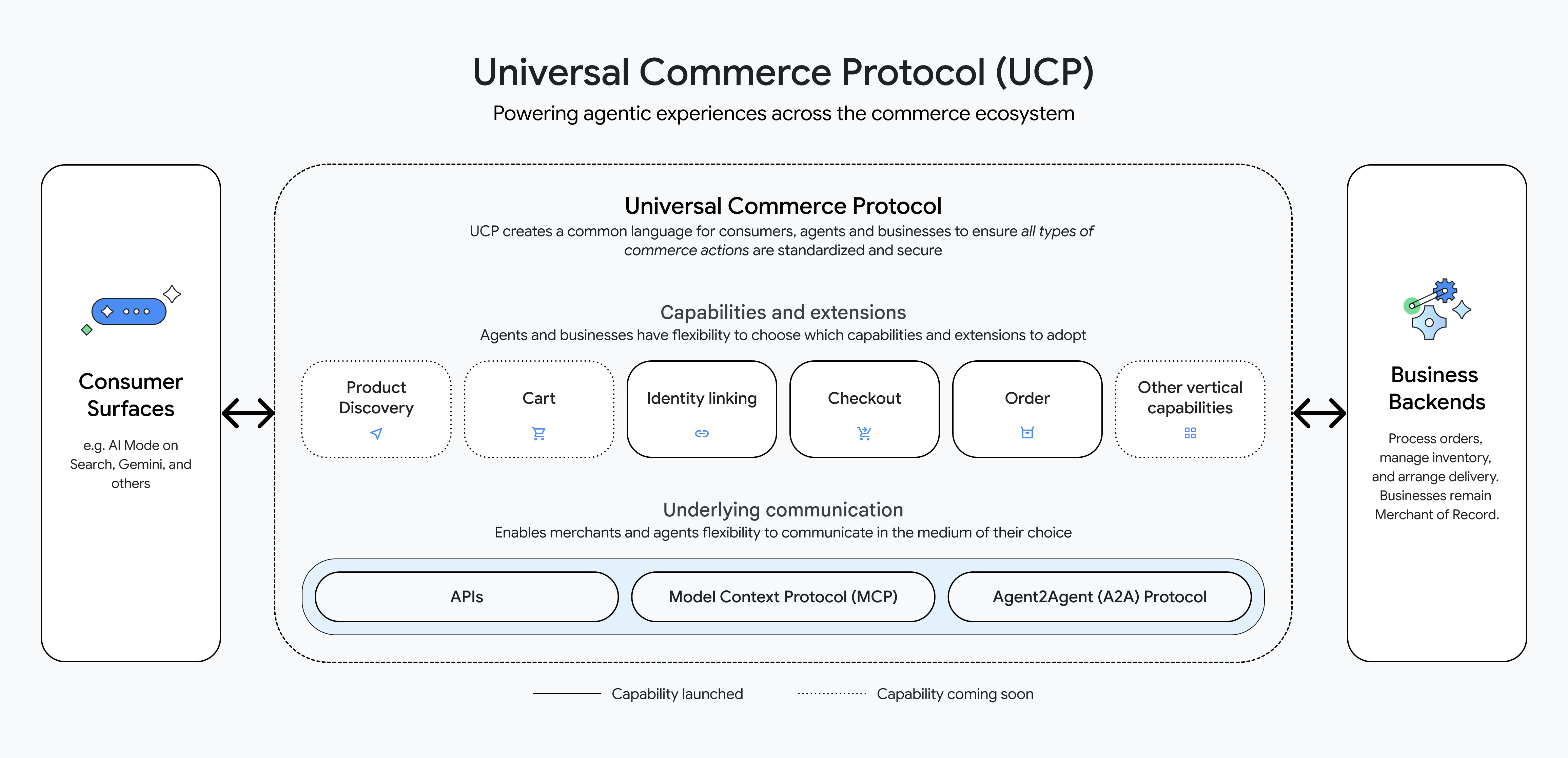
Google has positioned UCP as an open standard co-developed with major commerce partners, including retail and payments infrastructure providers. UCP is designed to connect merchants, AI systems, and commerce platforms using a common structure for product data and transactions. In practice, it allows AI systems to:
- Access structured product information from merchants
- Interpret product listings in a consistent format
- Support shopping experiences that take place inside AI-driven interfaces
Google describes the protocol as a way to enable transactions inside AI surfaces such as AI Mode and Gemini, using stored payment credentials through Google Pay and Google Wallet. More recent updates to UCP now include support for multi-item carts, catalog synchronization, and identity linking across retailers.
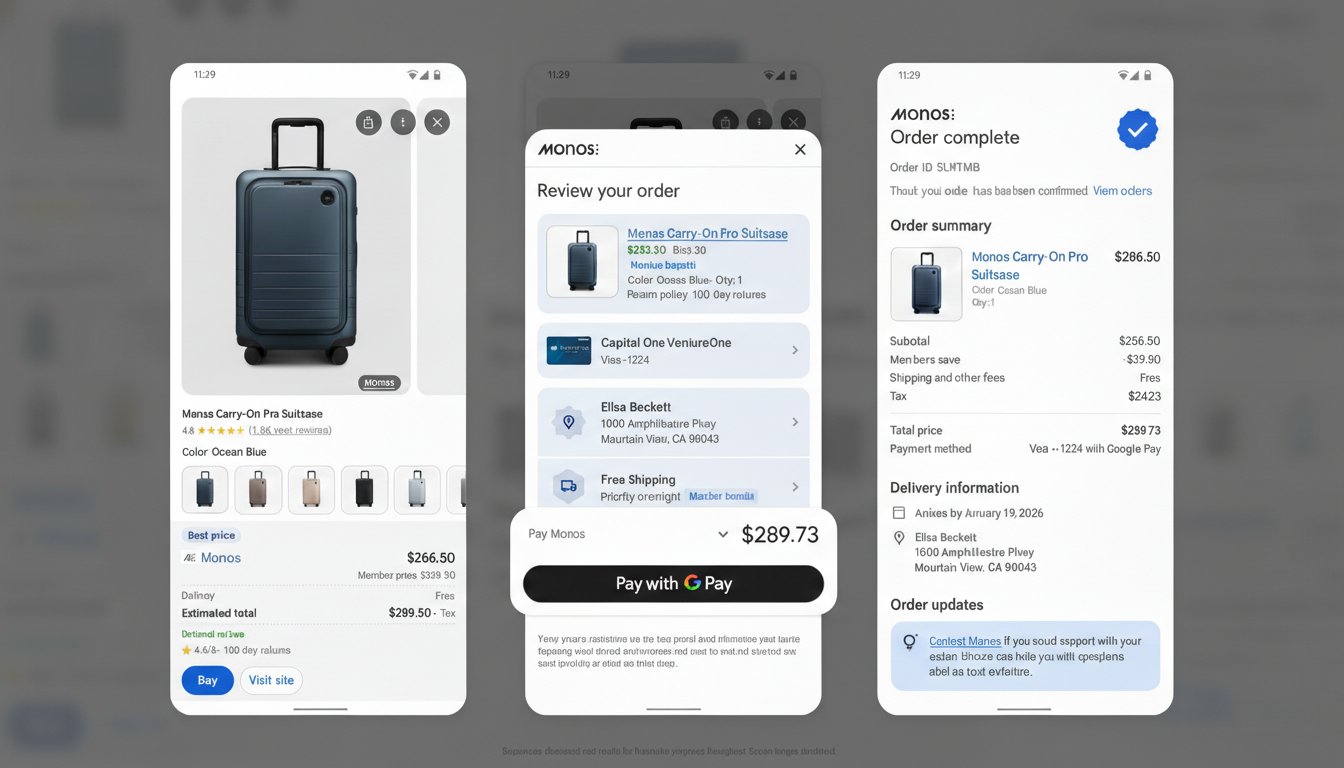
This effectively extends UCP from a checkout layer into a broader commerce infrastructure connecting merchants, users, and AI agents. Early implementations of this model show checkout experiences being tested directly inside AI Mode and Gemini for eligible retailers, with payments handled through stored Google Pay credentials.
This reduces reliance on traditional e-commerce navigation paths, where users typically move from search → product page → cart → checkout, to AI query → recommendation → checkout within an AI interface.
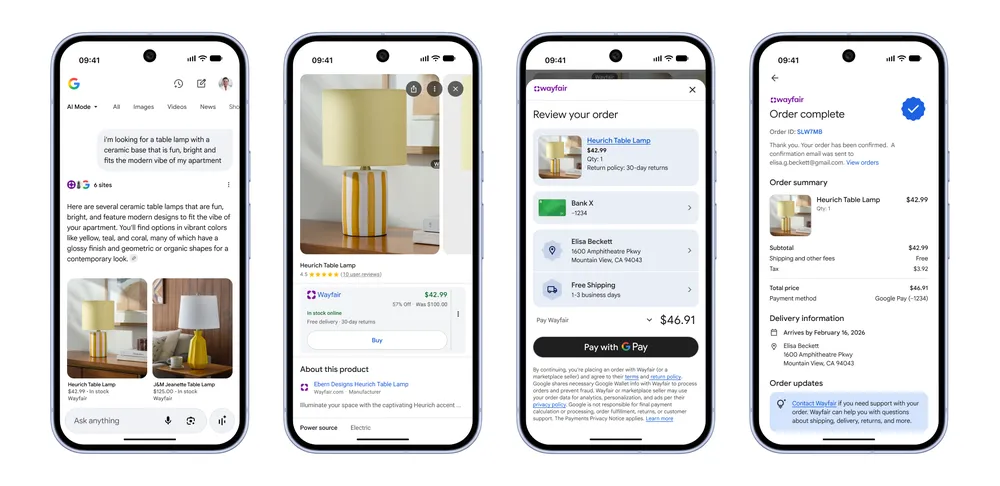
UCP checkout is also reportedly live in standard Google Search, allowing shoppers to complete purchases from Wayfair using Google Pay without visiting the retailer’s site.
To support the UCP system, Google has introduced structured onboarding pathways for merchants to connect their product catalogs and systems. This includes integration through Merchant Center and standardized data requirements designed to ensure product information can be interpreted consistently by AI systems.
YouTube Performance and Creator-led Ad Systems
Google has also signaled continued investment in YouTube as a performance advertising channel. YouTube has historically been used by advertisers primarily for upper-funnel objectives such as brand awareness and reach. However, Google’s recent product direction suggests a continued push toward making YouTube a full-funnel performance environment.
Recent updates across YouTube advertising include:
- Conversion measurement integration
- Expanded shoppable ad formats
- Links between video engagement and product discovery
- Improved attribution across connected campaigns
Industry reporting also shows that YouTube is increasingly being treated by advertisers as part of connected TV planning, with more budgets shifting toward living-room viewing environments and performance-based video placements.
One of the key developments in YouTube’s commerce direction is the expansion of shoppable ad formats that reduce friction between viewing and purchase. Recent announcements tied to YouTube’s advertising ecosystem show continued testing of product feeds within video ads, interactive shopping surfaces, and checkout flows connected to Google Pay infrastructure.
These formats aim to shorten the path from product discovery to transaction, particularly in environments such as Shorts and CTV placements where users are not actively searching, but are still receptive to product discovery.
A recent example of this direction is the introduction of “Buy with Google Pay” functionality on YouTube’s TV app, which it launched at its annual Brandcast event last week. The tool allows users to complete purchases directly from ads on connected TV.
Google is also integrating artificial intelligence into YouTube’s advertising workflow, particularly around creative production and campaign optimization. Across its advertising ecosystem, advertisers can use tools such as Gemini, Nano Banana, and Veo to generate or adapt video creatives and match ads with relevant content environments.
While these tools are not limited to YouTube alone, their application in video advertising is becoming more central as advertisers scale content production across Shorts, long-form video, and connected TV placements.
AI Transformation of Search and Gemini Integration
Search remains one of the most important pillars of Google’s advertising ecosystem, and ahead of GML 2026, the company has emphasized its ongoing transformation through AI.
Google has introduced AI-powered search experiences that provide more conversational and context-aware responses, changing how users interact with information before making purchase decisions.
For instance, Google’s Gemini AI model is being integrated across Ads, Search, and commerce workflows. The company’s direction suggests that Gemini will not only assist users but also support advertisers in campaign creation, optimization, and performance analysis.
What this Means for Advertisers and Marketers
Across the updates previewed ahead of Google Marketing Live 2026, the direction is consistent: AI is becoming an important aspect of Google’s advertising, commerce, measurement, and video ecosystems.
From automated bidding and budget allocation to Gemini-powered reporting dashboards and the expansion of commerce systems like UCP across AI Mode and Search, the company is integrating AI into the core mechanics of how campaigns are built, optimized, measured, and converted.
This is taking place against a backdrop of continued strength in Google’s ad business. In its most recent financial reporting, Alphabet reported $109 billion in total revenue for Q1 2026, with Google advertising accounting for the majority of that performance. Within that segment, YouTube advertising generated $10 billion in revenue in 2026, underscoring its growing importance as both a video platform and a performance-driven advertising channel.
The scale of these numbers matters in the context of Google Marketing Live because they reflect the economic foundation behind the company’s AI investments. Advertising remains the primary revenue driver, and YouTube continues to expand its role within that structure as a key surface for both brand and performance campaigns.
These developments show that the company is restructuring how its ad business operates around AI systems that influence everything from discovery in Search to shopping decisions in commerce environments and performance outcomes on YouTube.
As Google Marketing Live 2026 approaches, the focus is no longer on whether AI will be part of advertising. It depends on how deeply it will sit inside every stage of it.
Recap
What is Google Marketing Live 2026 about?

Google Marketing Live is a global livestream event where Google will showcase updates across Ads, YouTube, Search, and Commerce, with a strong focus on AI-powered advertising systems.
When is Google Marketing Live 2026 happening?
The event will take place on Wednesday, May 20, 2026, starting at 8:45 AM PT as a global livestream.
What new Google Ads tools are being previewed?
Google is previewing journey-aware bidding, Smart Bidding Exploration, and more dynamic budget pacing systems inside Google Ads. Google has also previewed a new Gemini-powered dashboards that let advertisers generate reports using natural language prompts instead of manual report building.