







Google has published an official help document explaining the Universal Commerce Protocol and how it supports commerce interactions on Google surfaces. The Universal Commerce Protocol is an open standard that Google describes as enabling agents and systems to work together across the entire shopping journey, from discovery through purchasing and post-purchase support.
The new support document, now live on Google Merchant Center Help, outlines how merchants should structure and share product data using UCP. This help page gives advertisers and e-commerce teams a view of how their product feeds connect to Google’s broader commerce ecosystem.

The documentation moves UCP from a concept discussed in industry coverage to a clearly defined specification within Google Merchant Center help resources. It outlines what UCP is, how it connects to AI-driven experiences, and what merchants must do to participate.
What is UCP
The help page explains that the Universal Commerce Protocol is a new open standard for agentic commerce. It establishes a common language for agents, consumer surfaces, businesses, and payment providers to operate together.
Under Google’s description, UCP works with other major industry protocols, including Agent2Agent, the Agent Payments Protocol, and the Model Context Protocol. These protocols handle different parts of the commerce lifecycle and help AI systems communicate structured information between user intent and merchant systems.
Importantly, the documentation notes that UCP spans product discovery through checkout and post-purchase support. This means the standard defines how product data, pricing, availability, fulfillment information, and business rules should be exchanged in a machine-readable format so AI agents can act on behalf of users.
How UCP-powered checkout works
The Merchant Center article explains that by integrating with the Universal Commerce Protocol, merchants can implement a checkout button on eligible product listings viewed in Google’s AI Mode in Search and the Gemini app. Google has already rolled out UCP-powered checkout on these surfaces.
Google says merchants remain the seller of record even when the transaction appears to occur on Google surfaces. This means brands retain responsibility for pricing, promotions, fulfillment, and customer relationships, even if the checkout interface is hosted on a Google property.
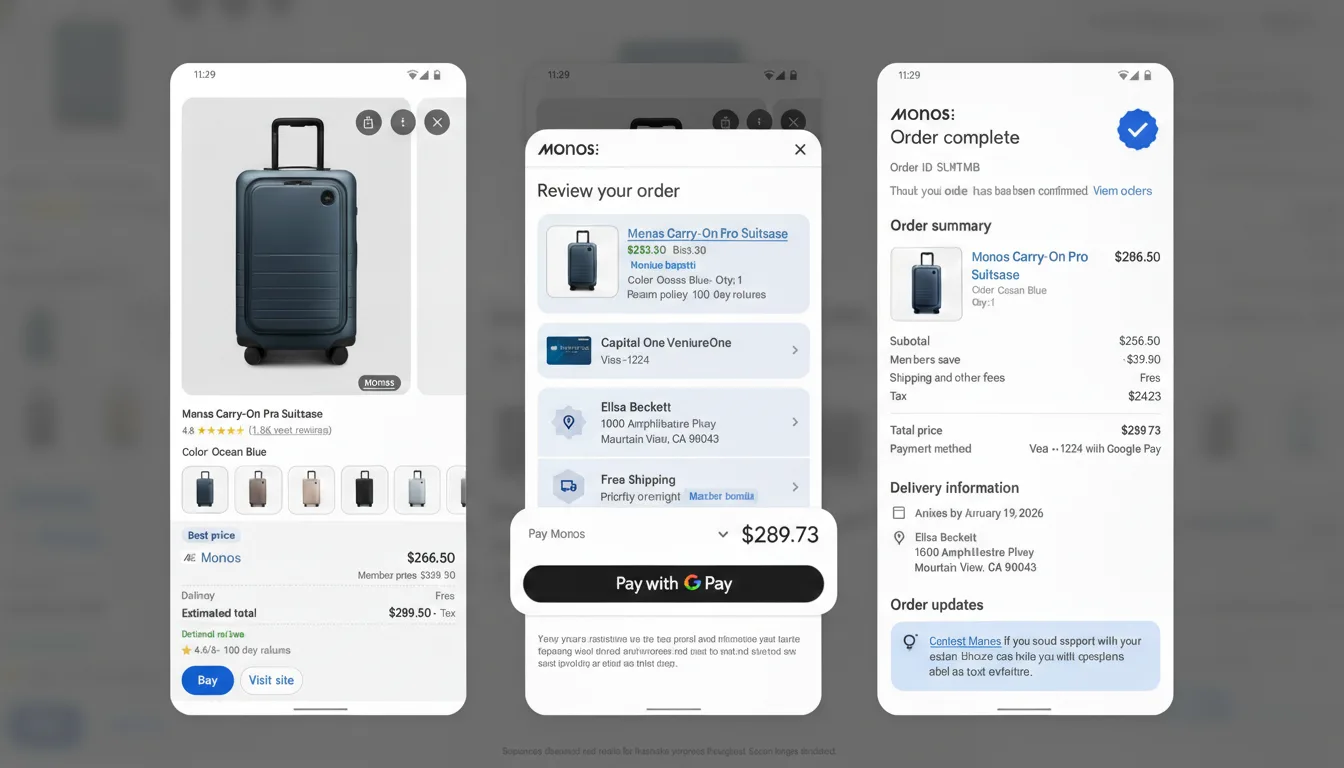
The help page notes that customers can use Google Pay with payment methods and delivery information saved in their Google Wallet. That integration currently relies on stored payment credentials. More payment types may be supported over time, but the existing system uses Google Wallet tokens.
To participate in the UCP-powered checkout feature, merchants must meet eligibility requirements and express interest through an interest form. This early access model indicates that not all merchants can immediately activate UCP checkout.
What merchants need to prepare
Participating merchants must prepare their Google Merchant Center data so product listings are ready for UCP-powered interactions. The documentation states that Merchant Center remains the hub for preparing product data used across Google surfaces.
As part of this preparation, merchants must use the native_commerce product attribute in their feeds for products that should display the Buy button driven by UCP. This attribute is a key signal Google uses to enable the specific checkout experience outlined in the help page.
The documentation also links to detailed implementation guides that cover how to structure product data, ensure completeness, and meet policy requirements. According to the UCP Developer’s Guide, merchants must first define their return policies in Merchant Center, as this is a Merchant of Record requirement and will be referenced on the checkout screen. Next, merchants must provide structured product data through Merchant Center feeds, APIs, or on-page markup. This includes core attributes such as price, availability, identifiers, and fulfillment details.
Merchants must also publish a machine-readable capability file, often referred to as a JSON manifest. This file signals to AI agents which commerce actions the merchant supports. For example, it can indicate whether native checkout is available.
The checkout flow must also be compatible with Google’s framework. The documentation explains that merchants need to enable specific attributes within Merchant Center and support secure payment credentials for transactions initiated through Google surfaces.
Under this setup, an AI agent can discover a product, confirm inventory and pricing, review policies, and initiate checkout within a Google interface if the merchant supports the required capabilities.
Where UCP fits into Google’s commerce ecosystem
UCP is part of a broader movement toward agentic commerce, where AI assistants can act on behalf of users to find and complete purchases. Google’s help page positions UCP as the infrastructure that enables this capability.
Google’s documentation makes it clear that the Universal Commerce Protocol is an open standard that defines how agents can interact with merchants programmatically. This includes product discovery, comparisons, capability negotiation, checkout initiation, and post-purchase flows.
Google is using the help page to provide a reference for merchants who want to participate in AI-driven commerce workflows and to clarify how UCP connects to existing systems such as Merchant Center, product feeds, and payment credentials.

Leigh McZenkie on what UCP changes for e-commerce.
“Your website is no longer just a destination. It's a data layer for AI agents. UCP lets AI agents complete purchases on behalf of users without the shopper ever visiting your product page. Discovery, checkout, post-purchase. All handled by the agent. That means your Merchant Center feed isn't just a ‘nice to have’ for Shopping ads anymore. It's your storefront for agentic commerce.
But here's the part most people aren't talking about: Trust is no longer a soft signal. It's a transaction gate. AI agents won't complete a purchase if your entity representation is inconsistent, your policies are unclear, or your structured data doesn't match your feed. This goes beyond E-E-A-T. This is "will the agent trust you enough to spend someone's money with you."

Recap
What is Google's Universal Commerce Protocol?

Google's Universal Commerce Protocol (UCP) is an open standard for agentic commerce that establishes a common language for AI agents, businesses, and payment providers to operate together across discovery, checkout, and post-purchase support.
How does UCP-powered checkout work for merchants?
UCP-powered checkout lets eligible merchants display a Buy button on Google AI Mode and Gemini listings. Merchants remain the seller of record, retaining control of pricing and fulfillment, while customers pay using Google Pay via stored Google Wallet credentials.
What do merchants need to do to participate in UCP?
Merchants must add the native_commerce attribute to Merchant Center feeds, define return policies, publish a JSON capability manifest, and submit an interest form. These steps signal to AI agents which commerce actions the merchant supports.