

Google launches Universal Commerce Protocol to connect AI agents with retailers
Google aims to lead agentic commerce amid competition from AI platforms like OpenAI


Google has launched the Universal Commerce Protocol (UCP), an open standard that connects AI agents and retail systems across the full shopping journey. This includes product discovery, purchase, and post-purchase support.
According to Google, UCP is designed to act as a shared language between AI systems and merchant platforms. Instead of retailers building separate connections for every AI assistant or platform, the company says UCP allows any compatible agent to interact with a merchant through a single setup.
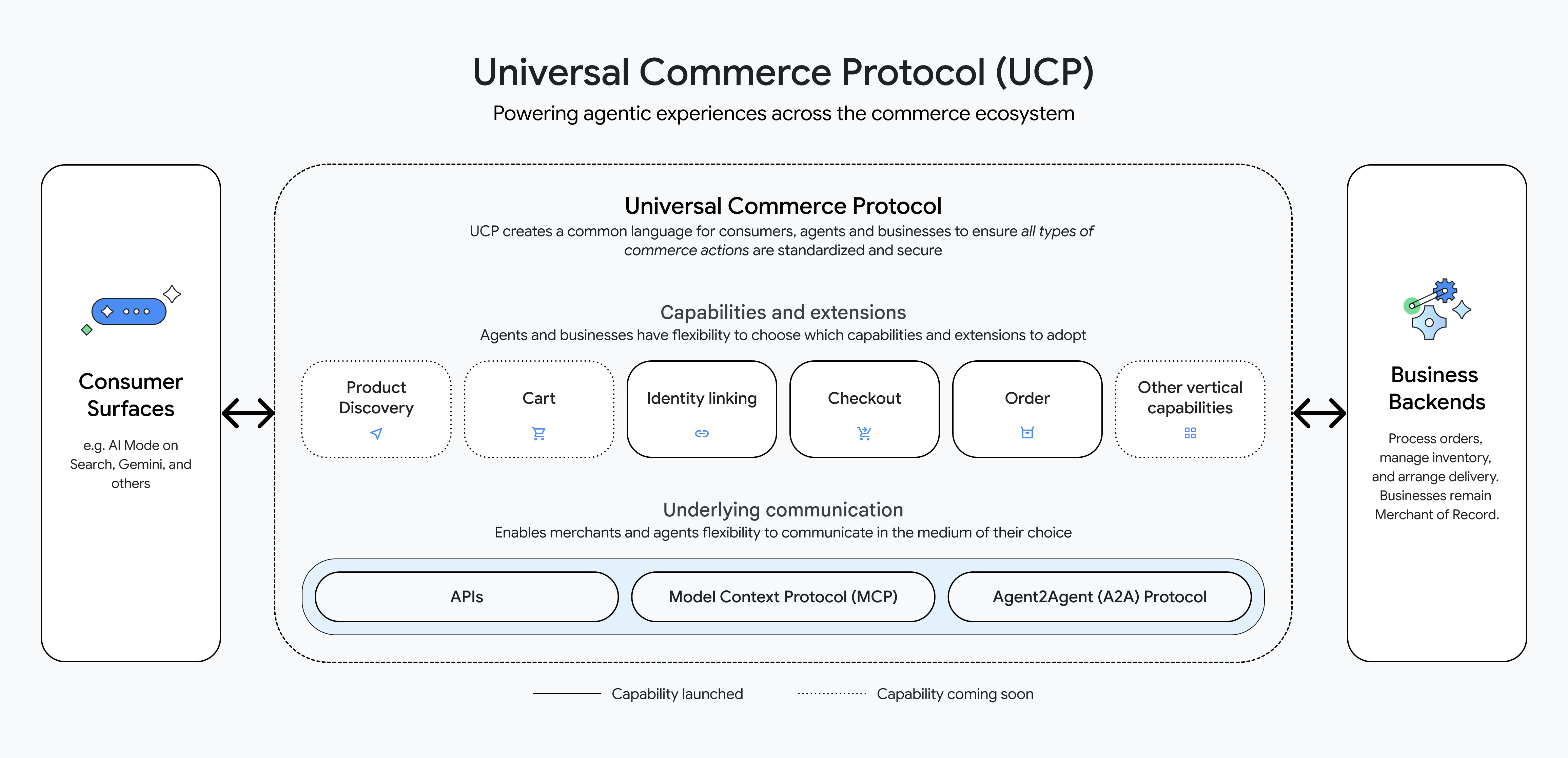
How UCP works across the shopping journey
Google says UCP creates a single system that spans search, payment, and support. In practical terms, an AI agent can surface a product, initiate a purchase, and handle follow-up actions without switching tools or integrations.
The company claims the protocol works across different industries and supports existing standards such as Agent2Agent, Agent Payments Protocol, and Model Context Protocol. This compatibility is meant to allow UCP to fit into current retail and payments infrastructure rather than replace it.
Google says the protocol was co-developed with companies including Shopify, Etsy, Wayfair, Target, and Walmart. In a post on X, Shopify CEO Tobi Lutke confirmed the partnership. It has also been supported by firms across payments, retail, and commerce technology, including Visa, Mastercard, Stripe, Adyen, and Zalando.
Checkout inside Google AI Mode and Gemini
Google says UCP will soon power a new checkout experience on eligible product listings in AI Mode in Search and the Gemini app. This means shoppers will be able to discover products, get recommendations, and complete purchases without ever visiting a retailer’s website.
This is an evolution of Google’s “zero-click” approach, which has previously reduced traffic to publishers by surfacing answers and snippets directly on search results pages.

Universal Checkout (UCP) now brings that concept to transactions. AI agents complete checkout directly with the retailer’s backend, while the retailer stays the merchant of record. As one Google VP put it, “Google is just the matchmaker.” Payment options currently include Google Pay, with PayPal support coming soon.
According to Google, merchants using Shopify will manage these transactions directly from Shopify Admin, even though the purchase happens inside a Google surface.
Google plans to expand the feature globally and add more capabilities. These features include discovering related products, applying loyalty rewards, and supporting custom shopping experiences built on the protocol.
What marketers should do now
To participate fully in UCP-powered experiences, retailers should ensure their product feeds in Merchant Center are complete and structured. Poor or incomplete feeds may reduce visibility, while clean, rich feeds including real-time pricing, availability, promo codes, accessory options, substitutes, and answers to common questions can increase the likelihood of products being recommended and purchased.
Business Agent brings brand conversations into Search
Google has also launched Business Agent, a new AI tool that allows shoppers to chat directly with brands in Search. Google describes it as a virtual sales associate that can answer product questions using a brand’s voice.
Business Agent will be available starting tomorrow with retailers such as Lowe’s, Michael’s, Poshmark, and Reebok. Eligible U.S. retailers can activate and customize the agent through Merchant Center.

Google says merchants will later be able to train the agent using their own data, access customer insights, offer related products, and enable direct purchases within the chat experience, including agentic checkout powered by UCP.
The setup is similar to Microsoft’s newly launched Brand Agents, which guide shoppers through product selection and purchasing inside Copilot.
Competition in agentic commerce is growing
Agentic checkout is becoming table stakes for AI platforms that want to compete in commerce. Each platform is trying to own more of the shopping journey, from intent and research to payment and post-purchase support. OpenAI, Microsoft, and Perplexity are all building systems that keep users inside their own AI interfaces.
Microsoft recently rolled out Copilot Checkout, which allows purchases to happen directly inside chat. OpenAI has also pushed deeper into shopping. In September, the company launched Instant Checkout, enabling users to buy products directly through ChatGPT. OpenAI has backed this with its Agentic Commerce Protocol, developed with Stripe. Like Google’s UCP, the protocol is open source and designed to let AI agents connect with merchants and payment providers without custom integrations. This puts OpenAI in direct competition with Google at the infrastructure level.
Perplexity in November launched Instant Buy, a conversational shopping and checkout experience powered by PayPal. Users can browse products, ask follow-up questions, and complete purchases without leaving the AI interface or opening a retailer's website.
Despite this competition, Google is aiming to remain central to how products are discovered and purchased as AI agents take on more of the buying process. The company has been expanding shopping features inside AI Mode, including agentic checkout, price tracking, and product discovery tools.