






Google has opened a preview of its Connected Apps Platform, which lets outside developers apply to put their apps inside AI Mode in Search and the Gemini app. The policy that governs those apps bans third-party advertising inside them.
When Google added Connected Apps to AI Mode in July, the first partners were Instacart, Canva and YouTube Music, and Google had not said how any other app could join. The Google announcement, published on 28 October, supplies that route. Developers build an app once and choose whether it goes live in Search, in Gemini or in both.
Google says it has launched more than 50 Connected Apps across the two products, in areas from productivity and event ticketing to health and fitness. It is opening the platform in phases and plans to add more developers, markets and Google products over the coming months.
How an App Gets Into AI Mode
Developers connect an app through the Model Context Protocol (MCP), the open standard that lets AI systems call outside tools. A cloud-hosted MCP server reaches Gemini and Search users on the web, Android and iOS. The second route, Android MCP, uses the AppFunctions APIs and reaches Gemini on Android only. Each app uses one route, and the choice cannot be changed later.
Registration runs through a new tool, the Google Connected Console. A developer picks a category for the app, which sets the capabilities it must support and is also permanent. The developer then lists at least three tasks the app can perform, which users see when deciding whether to connect it, and chooses the countries, languages and Google products where it should appear.
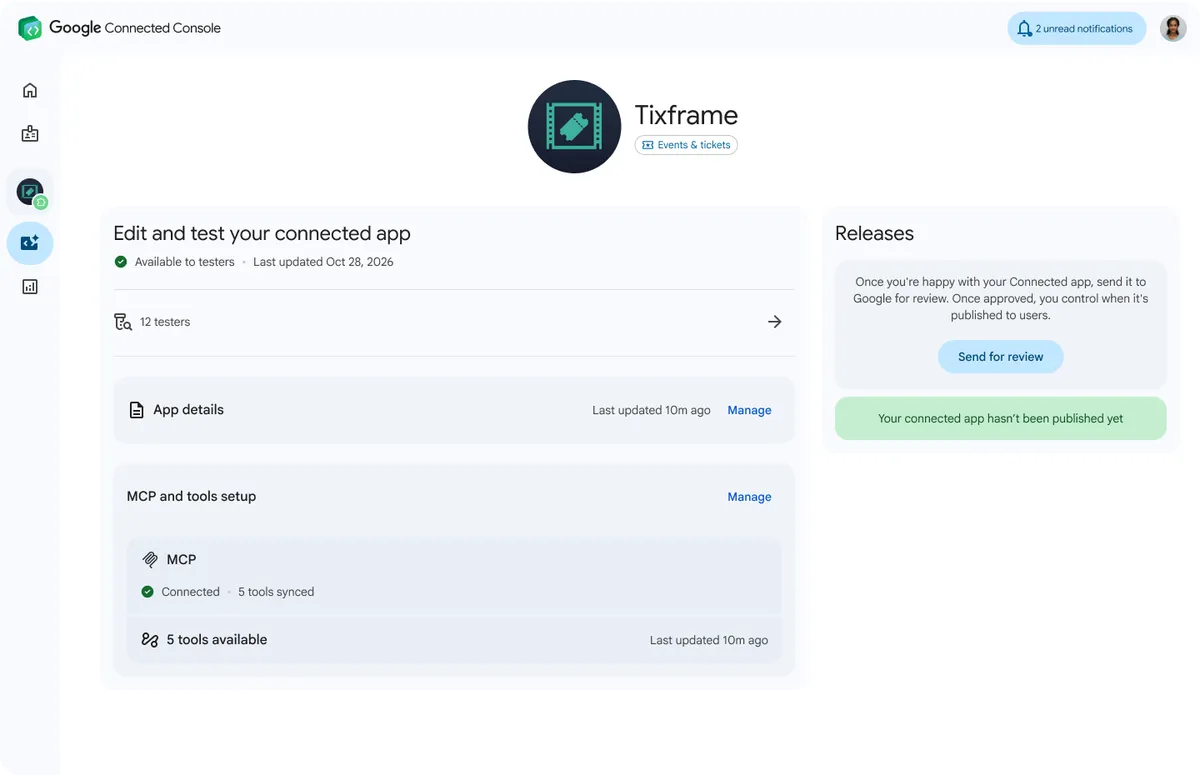
Google reviews and tests every app before it goes live. An app that needs a sign-in must come with test accounts holding realistic sample data, and Google’s documentation says an app it cannot fully test may be rejected. Once an app is live, the developer can track its traffic, latency and error rates, the only reporting Google describes.
No Advertising Inside the Apps
The Connected Apps policy gives advertising three sentences. Partners “must not serve any third party advertising content or promotional material through their integrations,” though their own brand elements are allowed. Every app must deliver “standalone value that is completely free of any advertising content.”
The policy does not say whether an app may promote its own paid tier. A breach can lead Google to reject an app at submission, suspend or remove it, or suspend or terminate the developer’s account.
A second set of rules covers how apps compete to be chosen. Google’s MCP server guide says AI models rely on a server’s instructions “to recognize when to delegate tasks to your server,” so an app’s own description works much like a ranking signal. The policy bars apps from using “overly broad or deceptive capability descriptions” to be selected over another app, from setting rules for how other tools are used, and from returning system instructions in their responses. Each capability has to be described in “distinct, unambiguous language.”
Ads in the Assistant, Not in the Apps
On the same day, Google expanded ads in AI Mode to ten markets outside the US and launched multiturn ads in US follow-up questions. Google is selling more advertising inside AI Mode while keeping it out of the apps AI Mode passes work to.
OpenAI has taken the same position for ChatGPT, which opened to third-party apps in October 2025. Its plugin guidelines say plugins “must not serve advertisements and must not exist primarily as an advertising vehicle.” OpenAI also bars pricing, free trials and discounts from app descriptions, and tells developers to avoid tool names such as “pick_me” or “best”.
 Google
 OpenAI
Where Connected Apps Run Today
In Search, Connected Apps work in AI Mode in the US, in English, according to Google’s Search help page. The page lists media, fantasy sports, grocery and design apps, and uses Instacart, Canva and YouTube Music in its examples. Users can name an app in a request or pick one from a list, and AI Mode may default to the last app used for a task.
Adobe, Experian, Localiza and Peloton are already live in Gemini, and Google says they will reach Search in the coming weeks. A new Calm integration is coming to both. Brands that want a place inside the assistant without buying an ad can now apply, provided their app carries no one else’s advertising.
Recap
What is Google’s Connected Apps Platform?

It is a single place for developers to build apps that run inside AI Mode in Search and the Gemini app, register them in the Google Connected Console and submit them for review. Google announced the preview on 28 October.
How does an app get into AI Mode?
The developer connects it through a cloud-hosted MCP server or Android MCP, picks a permanent category, lists at least three capabilities and chooses countries, languages and Google products. Google then reviews and tests the app before it goes live.
What does the policy change for brands?
A Connected App cannot serve third-party advertising or promotional material, though it may show its own brand elements. Getting chosen depends on what the app does and how clearly it describes its capabilities, and deceptive descriptions can cost a developer its account.