





.jpg)



For more than two decades, digital advertising has been defined by incremental innovations. From early display ads to real-time bidding, programmatic marketplaces, audience targeting, and automated optimization, each of these steps reshaped how advertisers spent money, tracked performance, and measured outcomes. But even at its most sophisticated, the industry remained bound by one fundamental truth: humans were ultimately in charge of decisions and actions.
Advertisers might have used machine learning to refine bids or adjust audiences based on signals, but they still manually assembled campaign structures, defined goals, and executed changes. That meant teams of analysts, media buyers, and creatives were still at the center of the campaign lifecycle. The automated tools simply supported them.
Today, that assumption is breaking down.
We are entering what many see as the agentic AI era, an era where intelligent systems can act, not just assist. Instead of waiting for human prompts at every step, these systems can plan workflows, make decisions within defined guidelines, execute actions across platforms, and adapt outcomes over time.
Industry analysts have warned that the transition to agentic AI is already a strategic imperative. AdTechRadar, referencing a Benchmark Company research report, argues that platforms that fail to adopt agentic AI risk becoming obsolete in an increasingly automated ecosystem.
According to the Benchmark report, agentic AI could transform multiple layers of ad tech, from creative development to programmatic buying. The report suggests that DSPs that fail to adopt multi‑layer agentic bidding and autonomous workflows will fall behind because these systems analyze thousands of variables in real time and optimize far more effectively than traditional rule‑based models.
EMarketer research also suggests that forward-thinking marketers should embrace these technologies. Their report notes that agentic AI can help marketers automate and optimize beyond human speed, providing faster insights, more responsive campaigns, and the ability to focus human effort on strategic oversight.
According to EMarketer:
“Agentic AI has even progressed into multiagent systems, where a grouping of AI agents work together to tackle complex challenges… and even troubleshoot issues as they arise.”
That evolution is beginning to ripple through every corner of the ad tech stack. DSPs (demand-side platforms), retail media, social advertising, AI agent frameworks, and foundational infrastructure standards.
This shift matters because it changes who does the work and how work gets done. It’s not merely about speed or efficiency, but about a transformation in agency, control, and capability that could reframe advertising paradigms for the next decade.
The Long Road to Autonomous Advertising
To understand where the industry is now, it helps to look back.
In the early 2000s and even into the 2010s, programmatic advertising automated what had been manual insertion orders. Media buyers gained the ability to target audiences and transact in real time through bidding marketplaces like OpenRTB. Yet, all of that still depended on human plans and execution: strategists defined audiences, chose creative sets, and monitored performance daily.
The first true waves of automation — dynamic bidding adjustments, rule-based budget pacing, automatic placements — reduced some repetitive tasks. But these systems were reactive and rule-bound. Advertisers still needed to step in when conditions changed or when broader strategic adjustments were necessary.
By the mid-2020s, generative AI started to change that calculus. Tools could write ad copy, suggest targeting options, and even forecast trends. But again, these tools assisted — they didn’t act autonomously.
Today, agentic AI alters that balance. It embeds intelligent decision-making into operational flows, reducing friction and enabling systems to operate across multiple stages of campaign development and execution.
Yahoo DSP: Internal Agents and Interoperability
Yahoo has long been a significant player in digital advertising, but its latest move with agentic AI in the Yahoo DSP marks a notable evolution in how programmatic media buying is executed. In January, the company rebranded its ad stack and embedded agentic AI directly into its DSP workflow. According to Yahoo, the integration allows advertisers to plan, activate, optimize, troubleshoot, and measure campaigns with unprecedented speed and insight.
Traditionally, programmatic DSPs were reactive tools. Media buyers would set campaign parameters, and algorithms would handle bidding and delivery. Even sophisticated AI previously in use mainly recommended adjustments or highlighted insights. Yahoo DSP’s agentic AI changes this, embedding decision-making directly into the campaign lifecycle.
Yahoo’s approach weaves agentic intelligence into every part of the media buying journey. Built on the company’s existing machine learning foundations, including early systems like AdLearn and Yahoo Predictive Audiences, this new system is designed to automate workflows previously managed manually.
How the system is structured
Yahoo describes this as a “Yours, Mine, and Ours” setup, where advertisers can use Yahoo’s native agents, their own agents, or both through APIs or MCP.
According to Yahoo’s press release, “Yours” allows advertisers to plug in their own AI models or agents, giving them the ability to execute workflows using proprietary logic. “Mine” refers to Yahoo’s native agents, which are built directly into the DSP and designed to handle tasks like troubleshooting delivery issues or optimizing performance. “Ours” represents a collaborative layer, where Yahoo’s data and external inputs are combined to generate recommendations such as audience expansion or targeting adjustments.
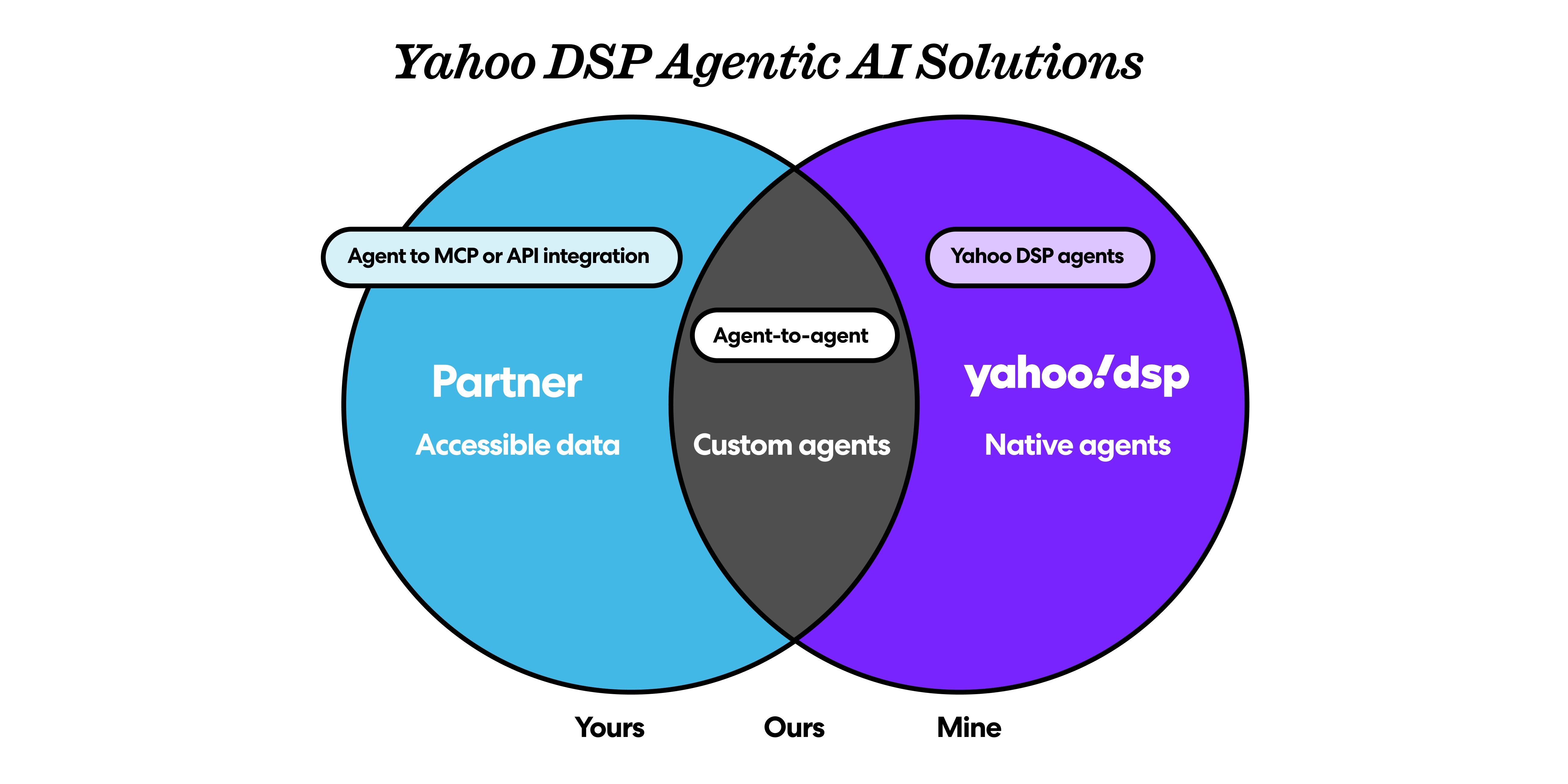
This hybrid model acknowledges that advertisers will want choice, transparency, and control rather than a closed monolithic system that arbitrarily makes decisions for them.
For example, one agent focuses on troubleshooting delivery and pacing issues — identifying root causes without human analysis — while another explores audiences at scale based on metadata, recommending where an advertiser might find better matches for goals that were once manually defined.
The most useful way to explain the Yahoo model to advertisers is this: instead of a trader spending time diagnosing underdelivery, building audience segments, or checking pacing manually, Yahoo wants an agent to do the first pass of that work.
In a YouTube interview, Yahoo DSP’s General Manager Adam Roodman emphasized that the goal is not to replace human decision-making, but to shift human effort away from repetitive execution and toward strategic oversight.
A Platform Becoming a System of Intelligence
What emerges from Yahoo’s approach is a platform that behaves less like a tool and more like a system. Early reactions from the market provide a more grounded view of its impact. According to Digiday, media buyers have responded with “cautious optimism,” describing Yahoo DSP as “one to watch” following its agentic AI push. But Digiday also noted that the broader DSP market is still dominated by large players such as Amazon, Google, and The Trade Desk.
Still, early partners including RPA and MiQ Sigma, have integrated external AI agents via Yahoo’s Model Context Protocol (MCP), linking their internal automation tools directly to the DSP. This has enabled programmatic guaranteed buys and campaign setup that previously required manual effort. Lisa Herdman, SVP at RPA, notes that agentic AI “removes operational barriers — enabling teams to focus on diversifying and maximizing marketplace partnerships in service of our clients’ business outcomes.”
Buyers are not treating this as hype, but they are also not fully convinced yet. The interest is tied to whether these agents can consistently deliver value in real-world campaign conditions, not just controlled demos.
An Experian’s interview with Yahoo DSP helps explain why Yahoo is leaning so hard into infrastructure. In that Q&A, Experian said Yahoo is shifting from “DSPs as destinations to DSPs as infrastructure,” and that the last decade of DSP competition was mostly about interface features.
This is a big clue to how Yahoo sees the market and where Agentic AI is headed.
Amazon’s Model Context Protocol: The Infrastructure for Agents
If Yahoo’s approach shows how agentic AI can be embedded within a demand-side platform, Amazon’s move reveals something more foundational: how agentic systems can operate outside interfaces altogether, through a standardized execution layer.
For years, Amazon Ads has been one of the most API-rich environments in advertising, particularly across Sponsored Ads, DSP, and Amazon Marketing Cloud. But like most ad platforms, those APIs were built for developers and structured integrations, not for intelligent systems that reason, plan, and act. Every workflow still required stitching together endpoints, managing authentication, and maintaining custom integrations.
That’s where the Model Context Protocol (MCP) comes in.
In early 2026, Amazon Ads launched its MCP Server in open beta, a foundational infrastructure component that translates natural language prompts from AI agents into structured API calls that ad systems can reliably act upon. This provides a translation layer between AI intelligence and operational APIs, eliminating the need for custom integrations that were previously the norm.
According to Amazon’s documentation, MCP acts as a core middleware that helps agents connect with Amazon Ads’ functionality — including campaign creation, performance reporting, account settings management, and billing retrieval — through a single, unified connection.
The MCP server works with Claude, ChatGPT, Gemini, and Amazon’s tools like AgentCore, Q and Bedrock.
What This Changes: From Manual Workflows to Agent Execution
The impact of Amazon’s MCP Server becomes clearer when we look at how advertisers actually manage campaigns today versus what becomes possible with agent-driven execution.
Before MCP: Fragmented, Multi-Step Execution
Until now, advertisers running campaigns on Amazon Ads have relied on a mix of manual setup and API-based automation.
For instance, launching a Sponsored Products campaign typically involves creating the campaign, setting up ad groups, defining keyword or product targeting, assigning budgets, and configuring bids either through Campaign Manager or via multiple API calls. Each step is executed separately, with dependencies managed manually or through custom-built integrations.
Reporting and optimization follow a similar pattern. Advertisers pull performance data through dashboards or APIs, analyze results externally, then return to adjust campaigns. Even with automation, this remains a task-based workflow built on multiple steps and systems.
With MCP: Unified, Intent-Led Execution
With MCP, those workflows are consolidated into a single execution layer.
Advertisers can instruct an AI agent using natural language, and the system translates that into coordinated actions across Amazon Ads.
For example, an advertiser can request: “Launch a Sponsored Products campaign for this product in the UK with a fixed budget and optimize toward conversions.”
Through MCP, that request triggers a structured workflow:
- Campaign creation
- Ad group setup
- Targeting configuration
- Budget allocation
- Bid strategy application
These are executed as a single coordinated operation, rather than a series of manual steps or API calls.
The same applies to optimization. Instead of manually pulling reports and making adjustments, advertisers can request performance insights and apply changes in one flow. The agent retrieves campaign data, identifies patterns, and executes updates such as budget reallocation or bid adjustments.
From Task Execution to Outcome Definition
The difference between these two models is a shift in how advertising work is structured. Previously, advertisers operated in a task-driven model:
- Build campaigns step by step
- Pull reports separately
- Manually coordinate optimization cycles
With MCP, the model becomes outcome-driven:
- Define the objective
- Let the system handle execution
- Intervene at the level of strategy and decision-making
This aligns with industry analysis. Futurum notes that MCP reduces multi-step campaign operations into single executable workflows. Analysis from Clearads highlights both the immediate gains and the emerging limitations. Tasks that previously took 15 to 20 minutes in Campaign Manager, such as building a Sponsored Products campaign or expanding into another marketplace, can now be executed in a single prompt. Bulk actions like pausing underperforming campaigns or generating performance reports are similarly reduced to conversational commands.
But that efficiency is uneven. According to SellerLabs, while execution tasks such as campaign creation happen almost instantly, reporting and data retrieval still rely on asynchronous systems, meaning performance queries can take significantly longer to return.
More importantly, MCP operates within the boundaries of Amazon Ads data. It does not account for inventory levels, profit margins, or broader business context, which means agents can optimize campaigns without visibility into whether those decisions are commercially sound.
The shift also introduces new operational considerations. Early guidance also suggests a more cautious rollout. According to Clearads analysis, advertisers adopting MCP-based workflows are advised to phase in automation gradually. That includes starting with read-only operations such as reporting and data analysis before allowing agents to make changes, implementing approval layers for any actions tied to spend, and requiring agents to outline intended actions before execution.
The Trade Desk and Claude: Conversational Programmatic Campaigns
While Yahoo embeds intelligence into media-buying workflows and Amazon abstracts execution through infrastructure, The Trade Desk is experimenting with a conversational layer on top of programmatic campaign creation. Through a closed beta with Anthropic’s Claude, advertisers can now describe campaign objectives in natural language, and the system translates that into fully configured campaigns inside The Trade Desk’s Kokai DSP.
From Step-by-Step Setup to Intent-Driven Campaign Creation
Building a campaign on The Trade Desk traditionally required multiple manual steps, such as defining goals, selecting audiences and data segments, configuring bid strategies, setting frequency caps and pacing, and preparing creatives. Each step was handled through the Kokai interface, requiring specialized knowledge and careful orchestration of multiple variables.
With Claude, the process shifts from step-by-step configuration to intent-driven execution. Advertisers can input instructions such as: “Reach new customers interested in fitness apparel in the U.S. with a $500,000 monthly budget.”
Claude interprets that brief, sets audience segments, selects appropriate targeting parameters, and translates the request into a campaign configuration that Kokai can execute.
Operational Considerations and Safeguards
Given that Claude integration is still under testing, industry guidance suggests caution with agentic campaign creation, similar to Amazon’s MCP adoption. Clearads-style practices — start with read-only workflows, require human approval for spend, and audit planned actions — are relevant here as well. Early tests emphasize verifying the model’s decisions before execution, ensuring that conversational brevity does not bypass strategic control.
Meta’s Manus AI: Agentic Assistance Inside Social Advertising
While programmatic and retail media platforms rethink workflows and execution layers, social advertising is also shifting under the influence of agentic AI.
In early 2026, Meta began rolling out Manus AI inside Meta Ads Manager — a move that reflects the company’s broader ambition to shift from manual workflows toward agent‑powered insight and assistance. This deployment follows Meta’s acquisition of Manus AI in December of last year for more than $2 billion.
Meta’s Manus AI brings agentic capabilities into Meta Ads Manager, allowing advertisers to interact with their campaigns conversationally.

Stephen Sunderlin, Marketing Committee Chair at Pennsylvania Presenters and an early tester of Manus said:
“Manus isn’t a simple ‘add-on’ or browser extension; it’s integrated at a deeper level. By granting it access via a limited-scope API token, it gains a fast and seemingly comprehensive view of the underlying data…it replaces the manual labor of exporting and wrestling with CSVs with high-speed, automated diagnostics.”
In addition to supporting performance analysis inside Ads Manager, Meta is extending agentic capabilities into adjacent workflows such as the Instagram Creator Marketplace, where influencers and brands collaborate on content opportunities.
How Advertising Worked Before Manus
Before Manus, advertisers had to export performance reports from Ads Manager and Audience Insights, manually compare metrics like ROAS, CTR, and conversions, analyze audience responses and creative performance across dashboards and deduce insights themselves, which often required hours of work or specialized expertise.
How Manus Changes the Workflow
Manus allows advertisers to ask natural-language questions and receive structured, actionable answers. Examples of queries include:
- “Which audience segments drove the most conversions last week?”
- “Which creatives had the highest engagement among users aged 25–34?”
- “Summarize performance differences across placements and formats.”
The AI interprets these requests, aggregates relevant metrics, and provides concise summaries that can guide decisions without manually navigating multiple dashboards. Kole Ogundipe’s YouTube analysis demonstrates how advertisers interact with Manus, showing practical insights generated directly in Ads Manager.
Practical Use Cases
Audience Research:
- Before Manus: Marketers manually filtered audiences and compared multiple segments.
- With Manus: Asking “Identify top audiences for last quarter’s campaign” delivers a ranked list based on ROAS, engagement, and spend.
Creative Performance:
- Before Manus: Teams compared dozens of creatives across placements manually.
- With Manus: Queries like “Which ads performed best in Stories this week?” yield summaries of engagement, costs, and patterns in under a minute.
Creator Marketplace Insights:
- Before Manus: Brands manually scouted creators, compared audience overlaps, and assessed content efficacy.
- With Manus: The AI can surface creator content that has driven measurable lift, helping marketers prioritize partners that contribute most to performance — bridging paid campaigns with organic and influencer reach.
Early Testing Reveals Strengths and Limitations
In real‑world testing, Manus’s capabilities have shown promise but also early limitations. According to testing reported by The Keyword, Manus can significantly speed up reporting work by allowing advertisers to request natural‑language summaries of campaign performance instead of navigating multiple dashboard views, filters, and exports. It can also surface performance anomalies, such as unexpected shifts in cost or delivery that might otherwise go unnoticed in manual analysis.
However, early tests also highlight challenges. Manus’s interpretation of Meta’s complex nested ad data has been inconsistent in some instances, and rollout accessibility varies by account configuration. Some advertisers still find it redirects to external sites or shows limitations in eligibility depending on campaign objectives, permissions, or platform rules.
Sunderlin offers an early-adopter perspective on human oversight: “The workflow improvement is immense, but it absolutely requires a skilled operator to guide it.” This reinforces the idea that Manus accelerates analysis but does not replace human judgment.
He warns about structural bias:
“Because Manus summarizes Meta’s data within the Meta ecosystem, it is structurally incapable of questioning the platform’s own incentives… The advertiser must retain ultimate interpretive authority.”
These mixed results reflect the fact that Manus is still in the process of refinement and broader deployment, not a finished system. The current focus appears to be on embedding workflow intelligence where it can accelerate analysis and insight generation, with future capabilities likely expanding as the model and integration mature.
Why This Matters for Advertisers and Teams
Across Yahoo, Amazon, The Trade Desk, and Meta, agentic AI demonstrates shared trends and these shifts have real practical consequences for how advertisers operate.
One of the most immediate impacts of agentic AI is speed and efficiency. Agentic AI can dramatically reduce the time taken for repetitive or complex workflows. Tasks that once required hours of setup, configuration, iteration, and manual review can now be condensed into single commands or prompts, freeing up human energy for higher‑value strategy and creative work.
For example, MCP tools demonstrate how multiple steps can be executed in one coordinated workflow, rather than a series of discrete API actions.
Human roles will evolve with the rise of agentic AI. The rise of agents does not replace human expertise, but redefines it. Teams will increasingly act as:
- Supervisors of outcomes rather than operators of tasks
- Governors of AI behavior and guardrails
- Strategic decision‑makers rather than execution specialists
This transition requires new skills, from agent oversight and prompt engineering to ethical governance and performance interpretation.
Another important aspect is control, transparency, and governance. While agentic AI can accelerate workflows, it also raises important questions about control and accountability. As systems begin making decisions on behalf of humans:
- How transparent are the decision paths?
- Who is responsible when outcomes diverge from strategy?
- How are data and permissions governed?
These questions will shape how organizations adopt and trust autonomous systems in critical marketing functions.
The Tension Between Standardization and Lock‑In
One of the most striking implications of this era is how it affects competition and platform dynamics. Platforms that integrate agentic intelligence deeply are positioning themselves as more capable and more advertiser‑friendly. But there’s also a risk that powerful, proprietary agent systems could increase lock‑in if they favor data and actions that cannot be ported easily to other environments.
Protocols like MCP, by contrast, signal a possible path toward interoperability where agents can operate across platforms using shared standards, reducing friction and enabling more flexibility. Whether this vision is realized depends on broader industry adoption of shared frameworks and open standards.
Challenges Still Ahead
Despite the momentum, this transformation is not without obstacles. For instance, adoption is uneven, as many tools, including Amazon’s MCP server, remain in beta and are not yet fully operational.
Trust also remains a major concern, with advertisers hesitant to give autonomous systems too much decision-making authority without strong governance. Even with rapid rollout, EMarketer’s research finds that “marketer distrust persists,” with only about half of media professionals comfortable trusting agentic AI to execute tasks.
According to General Assembly, only 39% of marketing and sales professionals in the U.S. and UK feel confident in their departments’ ability to use AI to drive revenues, while nearly half (46%) are ambivalent about AI for this purpose.
Beyond trust, integration remains complex. Even with protocol standardization, organizations must architect their data and systems carefully to support agent workflows effectively.
These challenges are typical of any disruptive change, but they also ensure that the industry will evolve through experimentation and iteration, not overnight.
Conclusion: A Shift in How Advertising Gets Done
The shift to agentic AI represents more than a collection of new products. It shows a deeper transformation in how advertising work is conceptualized, executed, and scaled.
What used to require manual planning, discrete API calls, and human oversight is increasingly becoming the domain of autonomous systems capable of reasoning, acting, and adapting with minimal guidance. Platforms like Yahoo DSP are building intelligence directly into workflows, while infrastructures like Amazon’s MCP are enabling agents to operate across environments.
For advertisers and media teams, this is both a challenge and an opportunity. Navigating this new world requires technical understanding, leadership in strategy, governance, and ethical control. Organizations that embrace these changes thoughtfully, by combining human judgment with autonomous capability, are likely to be the ones leading advertising into the next decade.
The question is no longer whether advertising will become agent-driven, but how much control humans are willing to retain as it does.
Recap
What is agentic AI in digital advertising?

Agentic AI refers to intelligent systems that can act autonomously across advertising workflows, making decisions, executing actions, and adapting outcomes without constant human intervention.
How does agentic AI differ from previous AI tools in ad tech?
Unlike earlier AI, which only assisted humans, agentic AI embeds decision-making into operations, reducing manual tasks and enabling multi-step campaign execution automatically.
How are platforms like Yahoo and Amazon using agentic AI?
Yahoo integrates AI directly into DSP workflows for planning, optimizing, and troubleshooting, while Amazon’s MCP server provides a standardized infrastructure for agents to execute campaigns across APIs.