


.webp)





A Productrise study of over 1 million product listings in Google Shopping results found that Walmart operates 1,600+ distinct seller names in organic shopping carousels, all linking back to Walmart.com. The analysis focused on three key metrics: seller diversity within carousels, seller diversity across full SERPs, and the products-per-seller ratio at both levels. The research exposes a gap in Google's diversity algorithm that has gone unaddressed since the company's 2019 site diversity update.
How the Mechanism Works
The study highlights Walmart’s distinctive approach. Walmart maintains individual Merchant Center sub-accounts for each third-party marketplace seller it hosts. The retailer operates over 1,600 distinct seller names in Google Shopping. Each sub-account appears as a separate entity in Google Shopping results. A shopper searching for wireless headphones might see a carousel with products from "Walmart - Samodra Direct," "Walmart - PHANCIR," and "Walmart - VARMINPOOL." Each is listed as a distinct seller, and each links to Walmart.com.
.webp)
Each seller name represents an actual third-party marketplace merchant with its own inventory, so the structure is technically legitimate. Walmart's setup differs from the standard multi-seller account, which consolidates all products under one seller name. The practical result is that Walmart gets 1,600+ chances to appear in diversity-filtered carousels, while a retailer with one identity gets one chance per carousel.
The Productrise study analysed results across 50,000+ first-page Google Shopping result pages during Q1 2026. Walmart was the only retailer operating at this scale. Amazon and Target did not replicate the model.
Why This Matters for Competing Advertisers
When Google's diversity algorithm treats all Walmart sellers as separate entities, perfect carousel diversity — where every slot comes from a different seller — drops from 13.7% to 9.3% when all Walmart-affiliated sellers are grouped as one entity. That is a 32% decrease.
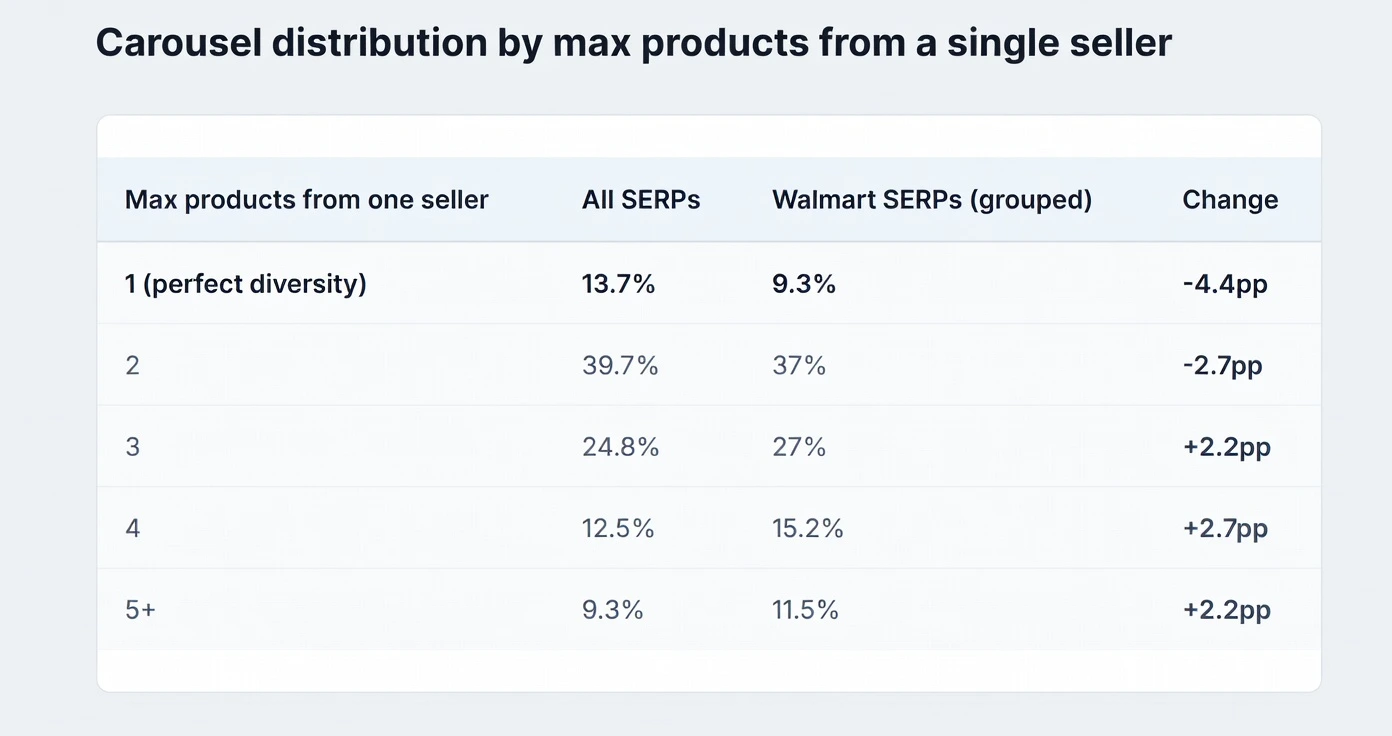
For advertisers competing against Walmart in Google Shopping, this creates a structural disadvantage. The structure represents a competitive edge most single-domain retailers cannot replicate. A brand selling the same product is disadvantaged not because its product is priced higher or lower quality, but because Google's algorithm counts Walmart 1,600 times and counts the brand once.
Even well-optimized product feeds cannot generate hundreds of distinct seller names. In highly competitive categories, Walmart’s marketplace can fill multiple carousel slots, potentially limiting visibility for smaller brands.
SEO and marketplace experts highlight this as a structural advantage rather than a promotional tactic. Jamie D'Alessandro, SEO Strategist at Amsive said that Google’s algorithms appear to favor Walmart, giving the retailer a notable visibility advantage that other major competitors, such as Target or Amazon, do not enjoy.
"Seeing that Google is amplifying Walmart, but the same behavior is not observed from other major retailers like Target or Amazon, is very interesting."
She further explained that this boost is particularly evident in Walmart’s multi-seller strategy, allowing them to dominate organic shopping traffic. According to her, this level of exposure raises questions about market concentration, as Walmart profits from every purchase made on its platform, even by independent sellers. Smaller brands, which often lack the inventory depth or brand authority of Walmart, are disadvantaged, losing potential visibility and sales they may never be able to match.
Kai Cromwell, Founder of New Seas, said:
“Shoppers may view this practice as misleading, which I think is a fair critique of Walmart from the consumer side of things. But from an SEO perspective, I think you have to tip your hat to Walmart. It's a brilliant play.”
The Algorithm Gap
Google's 2019 site diversity update addressed domain concentration in traditional web search, limiting results from the same domain to roughly two per page. But Google Shopping carousels operate under a different diversity framework. The algorithm counts seller names, not destination URLs or parent domains.
The Productrise study tracked the products-per-seller ratio throughout Q1 2026 and found it fluctuated between 1.36 and 1.51, indicating algorithmic stability. The algorithm is operating as designed. But it counts seller names, not destination domains. Walmart's 1,600+ seller names all resolve to Walmart.com. Google's algorithm does not apply any equivalent correction.
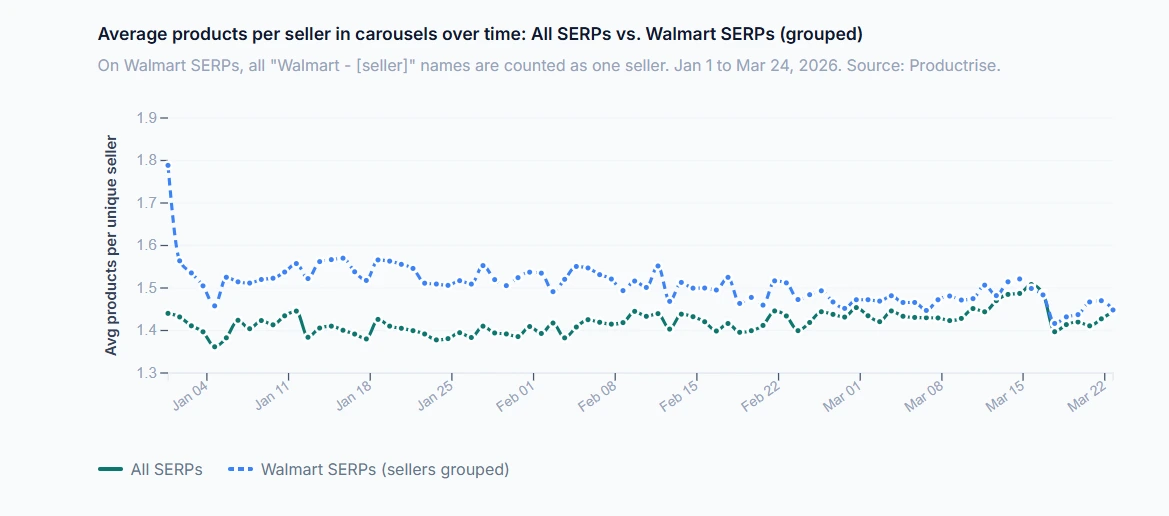
Callum Lockwood, SEO Director at Re:Signal, said:
"If a marketplace can occupy more carousel slots simply because of structure, that represents a competitive edge that most retailers don't have access to."
Implications for marketers and advertisers
For brands and advertisers, these findings highlight how the structure of a marketplace can influence organic visibility. Traditional single-domain retailers cannot replicate the same multi-seller approach, limiting their potential exposure in carousels.
Shoppers seeing multiple sellers in a carousel generally expect different stores, prices, or shipping options. When multiple slots link to the same retailer, perceived diversity does not match reality. This raises questions about the impact on competition and smaller brands, which may struggle to gain visibility against large marketplaces with deep inventory.
Walmart's reliance on Google Shopping organic visibility has increased. In March, Walmart abandoned its ChatGPT Instant Checkout integration after discovering in-chat conversion rates were 3x lower than direct clicks to Walmart.com, indicating that search and shopping visibility remains Walmart's primary growth channel.
A separate finding reinforces this: ChatGPT sources 83% of its product carousel data from Google Shopping. Walmart's position in Google Shopping carousels means Walmart-affiliated sellers will disproportionately appear in ChatGPT's AI shopping results, extending the structural advantage into AI-powered shopping experiences.
The question for Google is whether this gap warrants algorithmic revision. Google has previously refined its diversity algorithm in traditional search, such as the 2019 site diversity update, suggesting similar adjustments could occur for Shopping if perceived user intent is not met.
The bigger picture
The Productrise study reinforces the idea that organic Shopping is now a distinct channel for purchase decisions, not just a supplementary SERP feature. Understanding how seller structures, account setups, and algorithm interpretations work is essential for marketers, advertisers, and brands looking to optimize visibility.
Retailers and marketplaces now compete not just on product relevance and price, but also on how their account architecture interacts with Google’s diversity logic. Walmart’s strategy shows that structural setup can provide an advantage that direct feed optimization alone cannot replicate.
Recap
How does Walmart operate 1,600+ seller names in Google Shopping?

Walmart maintains individual Merchant Center sub-accounts for each third-party marketplace seller. Each sub-account appears as a separate seller entity in Google Shopping results, even though all transactions and fulfilment route through Walmart.com. This structure differs from the standard multi-seller account setup, which groups all products under a single seller name.
Why does this reduce carousel diversity?
Google's diversity algorithm treats each seller name as a separate entity and aims to show products from different sellers within a carousel. Because Walmart's 1,600+ seller names are all counted as distinct sellers, Walmart gets proportionally more carousel slots. When all Walmart-affiliated sellers are treated as one entity, perfect diversity drops from 13.7% to 9.3% — a 32% decrease.
Does Google's algorithm address this structural advantage?
Google's 2019 site diversity update addressed domain concentration in traditional web search, limiting results from the same domain. However, Google Shopping carousels count seller names, not destination URLs or parent domains. This gap means a single destination (Walmart.com) can occupy multiple carousel slots while appearing as diverse sellers to the algorithm.