








Google has introduced a new Generative AI performance report inside Google Search Console. The report shows how websites appear across its generative AI search surfaces, including AI Overviews and other AI-powered experiences in Search and Discover. Instead of mixing this activity with standard search traffic, Google is separating it so site owners can see AI-driven visibility on its own.
What the New Gen AI Performance Report Shows
According to Google’s documentation, the new report focuses on how URLs perform inside AI-driven search features. It breaks down visibility into key metrics such as impressions, pages, countries, devices, and time-based data. The new view sits inside Search Console at Performance → Search results, with a dedicated Generative AI tab. It counts impressions any time a link to a site appears in AI Overviews or AI Mode.
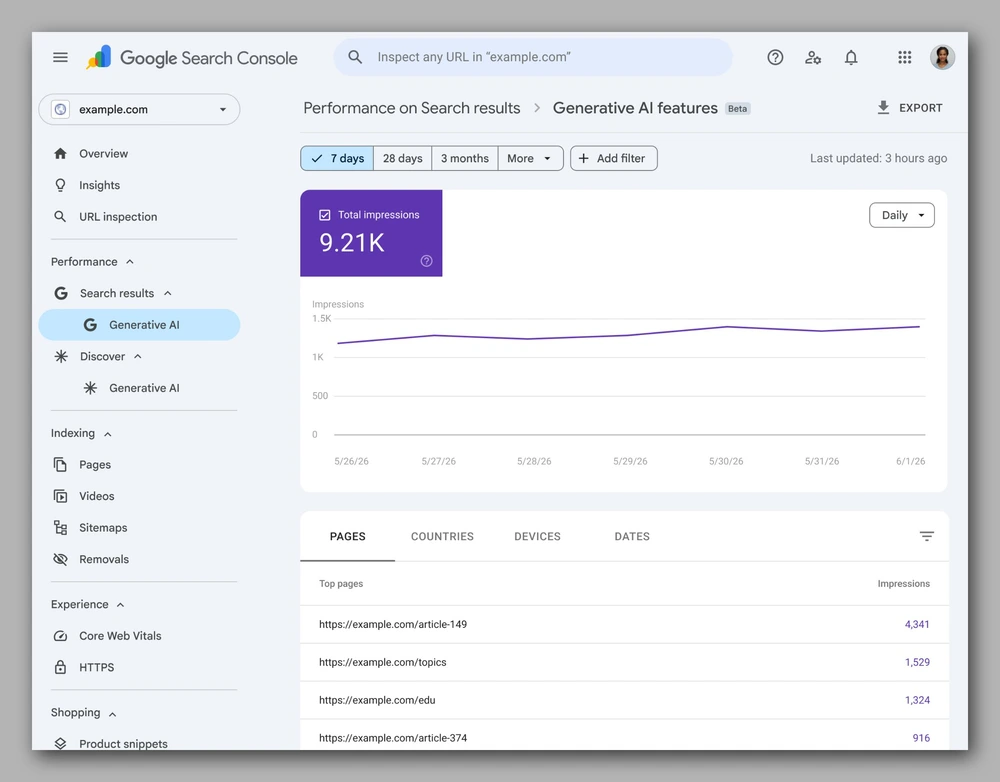
The company says impressions reflect when a URL appears within AI-generated search experiences like AI Overviews or AI Mode. This means a page can be counted as visible even if the user does not click through to the website, which is already a known challenge for publishers tracking AI-driven search traffic.
The report is also structured so that this AI-specific data still feeds into the broader Search Console performance report. That means advertisers can compare overall search visibility with AI-only exposure without switching platforms.
Rollout and Availability of the Report
The report is rolling out in stages to a subset of UK website owners and runs alongside a Discover report that covers AI Overviews inside Google Discover. The company has not given a fixed timeline for full availability, but it indicates the rollout will expand after feedback from early users. This mirrors how other Search Console features have been introduced in the past, where Google typically tests new reporting systems with a subset of site owners before scaling them more broadly.
Why Publishers and Marketers Were Asking For This Data
AI Overviews have already been changing how users interact with search results. Since the feature launched in the U.S. in 2024, many publishers and SEO practitioners have been asking Google for clearer reporting that shows whether content is being surfaced inside AI answers and how that affects visibility.
Until now, Search Console only provided combined performance data for clicks and impressions across traditional search. That made it difficult to isolate what came from standard rankings versus what was shown inside AI-generated summaries.
Practitioners also had to estimate AI surface visibility using third-party rank trackers like Authoritas, Semrush, Ahrefs, and Sistrix, or piece it together from server log analysis.
This new report is essentially Google’s response to that demand for clearer segmentation of AI search visibility. By separating AI impressions from traditional search impressions, advertisers could get a clearer view of where content is being surfaced, even when users do not click through.
There is also context around why this rollout is gaining attention now. AI Overviews have become more visible in search results, and regulatory pressure in some regions, including the UK, has pushed for more transparency and control over how publisher content is used in AI features. That broader environment is part of why AI-specific reporting is being closely watched by the SEO and advertising industry.
Part of a Wider Search Console Update
The report is part of a series of updates Google has been rolling out across AI Search. Today, the company also began testing a publisher opt-out toggle in Search Console, giving site owners both a way to measure visibility in AI surfaces and to exclude their content from being used in those experiences. The opt-out toggle is currently being introduced in the UK first. Previously, Google has also updated its guidance on AI optimisation for site owners.
Google’s documentation notes that this AI data is still part of the overall Search ecosystem reporting, but the separation is meant to give clearer visibility into where impressions are coming from.

Schwartz on Google Search Console’s new gen AI reporting and its impact on SEO visibility gaps.
“One of the biggest gaps in SEO reporting in the AI era is closing. The lack of visibility into how sites are showing up in AI is a significant driver of the growth of AI visibility tools that manufacture data. Having this report, even if it lacks deep details, will allow sites to:
- Know that Google is surfacing its content in AI
- Compare Google AI traffic to ChatGPT and others
- Make changes to improve their AI visibility
- Stop paying for tools with fake data.”

Recap
What is the new Generative AI performance report in Google Search Console?

Google Search Console now shows a dedicated report that tracks impressions from AI Overviews and AI Mode separately from the standard Search results data. A sibling report covers AI Overviews inside Google Discover. The report is rolling out in stages, starting with a subset of website owners.
How does the Generative AI performance report work?
The report counts impressions any time a link to a site appears in AI Overviews or AI Mode. Data can be sliced by Pages, Countries, Dates, and Devices, with the same 1,000-row table limit and Pacific Time aggregation as the standard performance report. The chart aggregates by property, switching to URL aggregation when a URL filter is applied. An export button is available.
What does the Generative AI performance report change for SEOs and publishers?
Until now, AI Overviews and AI Mode impressions were folded into the standard performance report's totals, which forced SEOs to use third-party trackers like Authoritas, Semrush and Ahrefs to estimate AI surface visibility. The new report removes that gap by surfacing the data inside Search Console itself. Google has said it will expand the list of AI surfaces covered over time.