








Last week, Meta introduced TRIBE v2, an open-source research model designed to predict how the human brain responds to content. The system is trained on brain-scan data from more than 700 participants who were exposed to video and audio stimuli. It combines visual, audio, and language signals to simulate how people process media at a cognitive level.
.webp)
Although Meta has not positioned TRIBE v2 as an advertising tool, the potential implications are drawing attention across the marketing industry. If a system can predict how people respond to content at a neural level, it opens the possibility of evaluating ads before they ever reach a live audience. In essence, it suggests a future where creative decisions could be guided by predicted perception.
What TRIBE v2 is and How it Works
According to Meta, TRIBE v2 is a tri-modal model. It processes visual, audio, and language inputs together and maps them to predicted neural activity. The tool attempts to map how people process content at a brain level rather than relying on surface-level engagement signals like clicks or views.
The outputs from these inputs are fused to create a shared representation of how the brain is likely to respond to new content. The system predicts which areas of the brain activate at which times, capturing attention and how content is processed across sensory modalities.
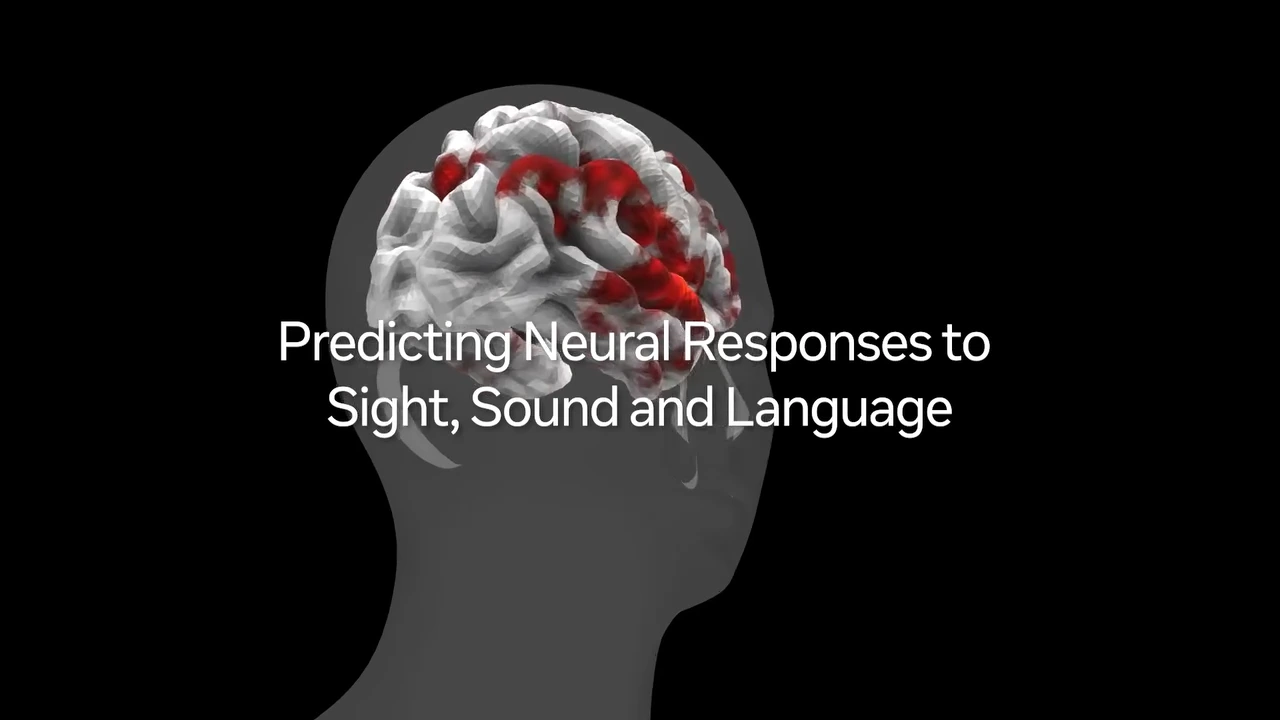
This multimodal approach reflects the way humans experience media, paying attention to video, audio, and text simultaneously rather than evaluating each channel in isolation. Time-based modeling allows TRIBE v2 to detect patterns such as spikes in engagement or moments where attention drops, providing granular insight that traditional engagement metrics cannot.
This is part of Meta’s broader work in what it describes as “in-silico neuroscience,” where AI models simulate human cognitive responses using large-scale datasets. According to Meta’s published research, the model improves significantly on earlier approaches. It delivers higher-resolution brain predictions and shows stronger generalization, meaning it can estimate responses for new content and new users without retraining.
Why this is getting attention in advertising
Advertising today is largely reactive. Brands launch campaigns, test multiple creatives, and optimize based on what happens after ads go live. Performance is measured through clicks, conversions, and other observable actions.
A model like TRIBE v2 suggests a different direction. It focuses on how content is processed before any action takes place. If applied to advertising, this type of model could be used to evaluate whether a piece of creative is likely to capture attention or trigger a response before it is shown to real users.
The system analyzes patterns in brain activity triggered by aspects such as color, motion, voice tone, facial expressions, and scene composition. By mapping these predicted responses, advertisers could identify which creatives are likely to capture attention, sustain engagement, or evoke emotional reactions. This could allow marketers to prioritize creative before launching campaigns, potentially reducing the need for extensive post-launch testing. In practice, this could resemble a pre-testing layer where ads are assessed before being deployed.
For example, a brand testing two video ads for the same product could use TRIBE v2 to analyze them. One video opens with fast-moving graphics and energetic music, while the other starts with a calm scene and a human narrator. TRIBE v2 could predict which elements are likely to capture attention based on simulated brain responses. The model might show that attention peaks in the first few seconds of the fast-paced ad but holds longer for the calm narrative.
Advertisers could then use this insight to select the creative that aligns with their campaign goals or adjust the ad by changing pacing, visuals, or audio before running it to real audiences. This points toward a future where creative evaluation happens before any live impressions.
Meta has not confirmed any of these use cases. However, the connection is being made because of how closely this aligns with the company’s ongoing investment in AI-driven advertising.
How this connects to Meta’s existing ad systems
To understand why TRIBE v2 matters, it helps to look at what Meta has already built.
Meta’s advertising stack has been moving steadily toward automation. Tools like Advantage+ reduce manual input by handling targeting, placement, and creative combinations. Advertisers provide assets, and the system determines how they are used.
More recently, Meta has discussed systems that can handle larger parts of the ad process with minimal human input. This includes generating variations of creative, testing them, and allocating budget dynamically based on performance signals.
Meta has also been expanding toward more autonomous ad workflows. This direction aligns with broader developments in AI systems that move beyond prediction into execution. Tools such as Manus, which the company has integrated into Ads Manager, are designed to take actions based on model outputs, not just provide recommendations.
Behind this, Meta’s retrieval and ranking systems handle large-scale decision-making, processing millions of potential ads and narrowing them down in real time — the same delivery mechanics our guide to the Meta ads algorithm breaks down in detail. On its Q2 2026 earnings call, Meta introduced Meta Generative Recommender, an LLM-based system that reasons about creative content and user preferences together rather than scoring each ad individually.
But these systems still rely on observed behavior. They learn from what users have already clicked, watched, or ignored. This could be where TRIBE v2 introduces a different type of signal. Instead of relying only on past performance, it models how people are likely to respond at a cognitive level. If integrated into ad systems, this could shift part of the decision-making process from observed outcomes to predicted perception.
When viewed together, these layers start to form a pattern. One system generates or evaluates creative. Another predicts performance and selects ads. A third executes decisions at scale.
TRIBE v2 does not complete this system, but it fits into it. It introduces a way to evaluate content before it enters the cycle of testing and optimization.
The gap between research and advertising
There is still a clear gap between what TRIBE v2 does today and how it could be used in advertising. Meta’s research focuses on neuroscience modeling, not campaign outcomes. There are no announced plans to integrate this model into ad products.
There are also practical limits. Ad performance depends on multiple factors beyond attention or cognitive response. Pricing, targeting, competition, and placement all influence results. A model that predicts brain activity would need to be combined with these signals to produce reliable advertising outcomes. Because of this, any direct application to ad performance remains unconfirmed.
What this signals for advertisers
Even without a product launch, the direction is becoming clear. Meta is expanding the types of signals it uses to understand how people respond to content. For advertisers, this suggests a gradual shift. Creative strategy may move closer to predicted response rather than relying only on post-launch testing. The role of experimentation could change if systems begin to filter or rank creative before it is shown to users.
It also raises questions about visibility. As models become more complex, advertisers may have less clarity on why certain creatives are prioritized or how decisions are made. This has already been a point of discussion with automated tools like Advantage+.
Updated 1 August 2026. Source: Meta Q2 2026 earnings call transcript.
Recap
What is TRIBE v2?

TRIBE v2 is an open-source research model developed by Meta that predicts how the human brain responds to content. It combines visual, audio, and language signals to simulate how people process media at a cognitive level. The system is trained on brain-scan data from over 700 participants exposed to video and audio stimuli.
How does TRIBE v2 work?
TRIBE v2 is a tri-modal model. It takes visual, audio, and language inputs together and predicts which areas of the brain activate at which times. This allows it to map attention, engagement, and emotional response to content over time, offering insights beyond traditional metrics like clicks or views.
Could TRIBE v2 be used for advertising?
Meta has not positioned it as an advertising tool. However, marketers are exploring the possibility that it could predict how ads will capture attention or evoke reactions before reaching a live audience. This would allow creative evaluation based on predicted perception rather than only post-launch performance.