

Every publisher keeps the same unattended drawer. An article's search traffic peaks early and then slides, while the people who made it are three stories further on. Reviving it is known, cheap and dull work: the titles answering a question nobody asks, the queries stalled a place or two off the first screen, the pages shown constantly and clicked almost never. Every content team can describe that list. Very few work through it, because it has to be scheduled against publishing, and publishing wins every week.
The Keyword is an unusually clean test of what happens when something else is scheduled instead. The articles here are produced by agents: one finds the stories, one decides which are worth running or passes on the day, one researches, one writes, one makes the image, at up to an article a day. Since late June 2026 the search maintenance has been handed to a separate agent, built by Agent Place. Agent Place and The Keyword share an owner, so this is a related company's software being described by the publication it was pointed at; that relationship is the reason the data below is available at all, and the reason the limits on it are spelled out as carefully as the figures.
What follows is the method, the numbers with their windows, and the part of the record that turns out to be the most useful to copy.
The weekly loop, in three moves
The agent runs weekly against the site's own Search Console data rather than a third party's modelled estimate of it. A run does a good deal more than this, but three parts of it are the ones worth copying.
It weighs recent demand against context. Two windows are pulled, a seven-day one and a twenty-eight-day one, both ending three days back because Search Console's figures take about that long to settle. The comparison exists to stop a query that spiked around an event last month from outranking something people are searching for this week. What it hunts for above all is impressions rising while clicks sit still, a page already being shown to the right audience and failing at the one step that is purely a matter of copy.
It reads the page before it edits it, then rewrites the elements that decide a click: the title, the meta description, the headings, and the passage that ought to be answering the query. Its remit is wider than metadata: since July 2026 it has written new body sections outright, and it has corrected a dated assertion that an already-released product was still forthcoming. What it is held to, in place of a narrow scope, is an accuracy bar. It may not invent a fact, a statistic, a person or a quotation, and it writes in the third person. A change that needs a designer rather than a content field is filed to a separate queue rather than blocking the run.
It records the decision either way. When it takes on the week's one opportunity, a dated line is appended for it. When it examines a page and decides to leave it alone, that decision is logged too, with the reasoning written out beside it. Edits are written straight into the content management system the articles already sit in.
None of that is a technique a search consultant would be surprised by. The only thing that is different is the frequency, on a site where the alternative was nobody doing it at all.
Two figures, and what they are not
Two things moved into October 2026 on The Keyword's own properties.
Arrivals from AI assistants (ChatGPT, Gemini, Copilot, Perplexity and the rest), identified by referral source in GA4, were up 79% from September to October, with ChatGPT accounting for the large majority of the increase. Separately, in Search Console, clicks from Google more than doubled between 1–29 September and 1–29 October, a deliberately like-for-like window. The interesting part is that they doubled on fewer impressions: site-wide click-through rate rose from 0.07% to 0.17%. More clicks from less visibility is a click-through outcome rather than a ranking one, and click-through is the layer this agent operates on.
Neither figure is offered as evidence that the agent caused it, and The Keyword does not claim that it did. Both measure the whole site over a single month, and on this site the articles are machine-written too, so the search maintenance cannot be separated from the publishing beside it, or from the news cycle, or from the season. They are reported next to the work, in that order, with the join between them left open, which is the honest position, and the one worth demanding of any agency case study published this quarter, including a related company's.
The set-asides are the part to steal
One claim about this agent is checkable rather than inferential, because it is a claim about the agent's own conduct instead of about traffic: it writes down the pages it decided not to touch, and why.
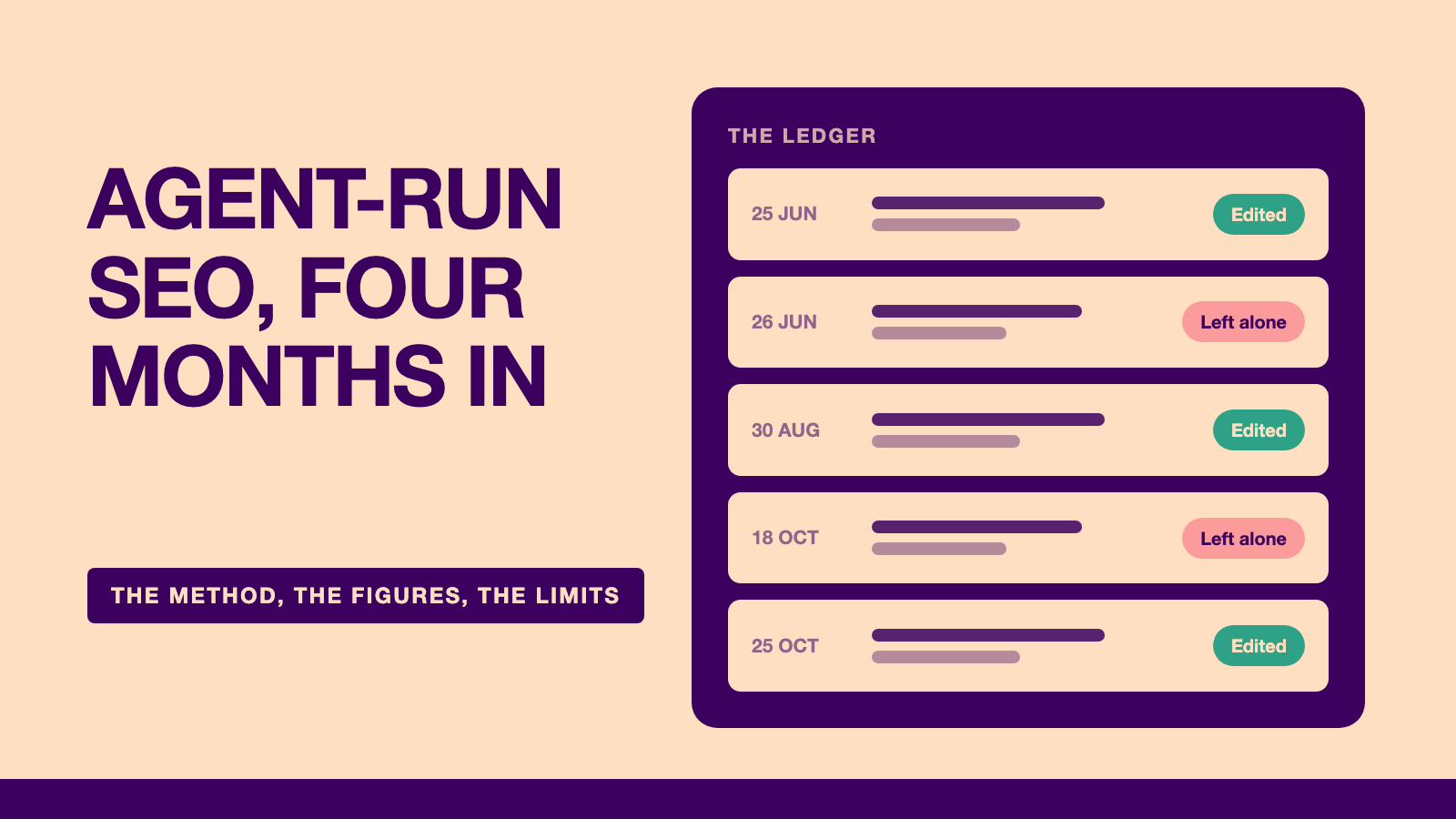
As at 25 October 2026 the ledger held 36 dated lines running back to 25 June. Twenty-four of them were work carried out, a few pages actioned more than once. The other twelve, a third of the file, were refusals, each with its reasoning left on the line. The most instructive is also the most permanent: Google publishes its own company blog under the name The Keyword, so the query "the keyword" is a brand collision this site cannot win on-page, and the agent has logged that conclusion repeatedly, across three different wordings of the query, rather than quietly retrying it. The rest range from result pages a platform owns outright to targets the domain has no authority to reach.
A third of the output being a documented decision not to act is a strange shape for automated SEO, and it is the shape that makes the rest of the file worth reading. An agent that edited every page it was pointed at would produce a longer ledger and a worse site. The refusals are also the only part of the record capable of embarrassing it later: a stated reason can be disagreed with next quarter, which is more than an undocumented judgement call survives. Any team running this kind of work manually would benefit from the same artefact, and almost none keep one.
What the ledger does not contain is a page-level win. No count of pages improved appears in it and none is claimed here, because the before-and-after on individual pages cannot be separated from the ordinary decay of a news article edited days after it was published.
Search and assistants are now two jobs
The more portable lesson sits underneath both figures. A question answered by a page can now be put either to a search box or to an assistant, and the two reward different things. An assistant reaches for whichever page makes the answer easiest to extract and repeat, and that is not reliably the page holding the highest position.
That is why arrivals from assistants are tracked here as their own figure rather than folded into organic search: the work that earns them (answer-first paragraphs, question-headed sections, specifics left in rather than smoothed out) is not the same work that earns a ranking, and a team measuring only Search Console is measuring one of the two routes its content now has. Related reading: AI marketing engineering.
Trusting an agent with a live site
On this site it has done so weekly since late June 2026, and the scope is not as narrow as the question tends to assume: most of what lives in a content field it writes without an approval wait, body copy included, though a few fields stay reserved for the site's owner. What makes the arrangement reviewable is not a restricted remit but an accuracy bar (no invented facts, statistics, people or quotations), together with the fact that its decisions, including the decisions to do nothing, land on dated lines somebody can audit afterwards.
Attribution, and why none is claimed
Not on this evidence, and no such claim is made here. One month of whole-site figures, on a site where the articles are themselves machine-written, cannot isolate one agent's contribution from everything else that ran that month. The ledger is the only part of this story that belongs to the agent alone.
The AEO half of the work
Answer engine optimisation means earning a quote rather than a click: an assistant extracts whichever page states an answer most clearly, so the shape of the answer counts for more than the authority of the URL carrying it. The 79% figure above is the measurement of that channel, kept apart from organic search for exactly that reason.
Where the limits are drawn
Mostly not around which parts of a page may be edited, which is the intuitive place to look. A few fields are reserved for the site's owner, but the substance of an article is not among them. The limits that do the work sit around accuracy and around winnability. Nothing may be invented: no fact, statistic, person or quotation. Anything presented as sourced has to be checkable word for word in the source cited. Separately, a target the domain has no realistic chance at is abandoned rather than attempted, and the abandonment is written down. The first limit governs how an edit gets made; the second decides whether there is an edit at all.
Disclosure
Agent Place, which built the agent described here, and The Keyword, which publishes this article, share an owner. The work was carried out on The Keyword's own site. The traffic figures come from The Keyword's own Search Console and GA4 properties, read on 31 October 2026; the ledger figures come from the agent's own log of what it changed, counted to 25 October 2026.